Tax Transparency as Corporate Social Responsibility: Evidence from Impact investing, social enterprises, SDGs, impact measurement, social-impact reporting
Kazi Rukaiya Sultana (Master of Public Policy & Master of Social Welfare and Research)
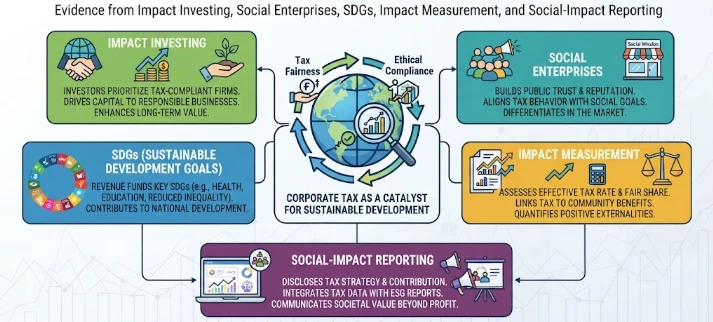
This article connects tax transparency with impact investing, social enterprises, the Sustainable Development Goals and social-impact reporting. It argues that corporate tax responsibility cannot be judged from a single effective tax rate because losses, incentives, grants, cross-border structures and timing differences can materially affect results. For impact investors, the key issue is separating market performance from value created through public fiscal support, including tax concessions and guarantees. Social enterprises face a similar challenge because trading income, grants, concessionary capital and tax preferences can all influence ordinary profit measures. The article therefore favours impact frameworks with clear objectives, indicators, baselines, contribution and risk of shortfall rather than broad SDG labels. Tax transparency adds a fiscal dimension by showing how public resources support claimed social outcomes. The discussion also covers corporate governance, sustainability reporting, social licence, inclusive capitalism, public procurement and public-private partnerships. Credible reporting requires consistent definitions, explanation of material changes and links between financial, tax and impact information. Transparency creates public value when it improves decisions, reveals inconsistencies and enables accountability rather than merely increasing the volume of disclosure.
Tax transparency is no longer about whether a business is late for filing tax returns. The relevance of tax strategy to corporate governance, sustainability statements, public perception and business value creation is a topic that is increasingly being explored by investors, employees, customers, governments and communities. The transparent approach clarifies the link between the statutory requirements, the effective tax result, incentives, losses and the cross-border structure without simplifying a complicated position to one headline ratio. The context is a key element of corporate social responsibility, since tax forms part of the funding for institutions and infrastructure that form the basis of commercial activity.
Tax transparency is relevant to impact investing since tax incentives can affect financial returns and measurable social impact. A strong social enterprise portfolio performance fund should identify operating value from value granted through grants, credits, guarantees or preferential tax treatment. PRI case studies prior to the publication of this document more and more focused on structured impact-management frameworks with specific objectives and indicators. That way, there is less danger of an SDG label for evidence.
Social licence is a notion that goes beyond the legal authority to use a resource and refers to its acceptance based on reputation. Firms in the resource, infrastructure, finance and the digital industries frequently rely on community and regulatory trust and contract rights. Tax behaviour may affect that trust as profits may be dependent on public infrastructure, educated workforces, legal systems and government assistance. It's transparent tax governance that isn't about publishing all the private information but rather enough context that it's clear that legal compliance and declared social obligations are not pulling in opposite directions.
Inclusive capitalism focuses on distributing value creation as the core of governance. Corporate activity reaches stakeholders through various channels, such as wages, payments to suppliers, taxes paid, investment, dividend payments and community impacts. The choice of metrics can highlight those pathways, and ESG reporting can help reveal those trade-offs. Tax transparency also provides a more tangible fiscal aspect, as it displays contributions and incentives across jurisdictions. The best disclosure neither announces totals nor offers a straightforward comparison of the effective rate, but rather discloses material drivers in a way that allows for informed review.
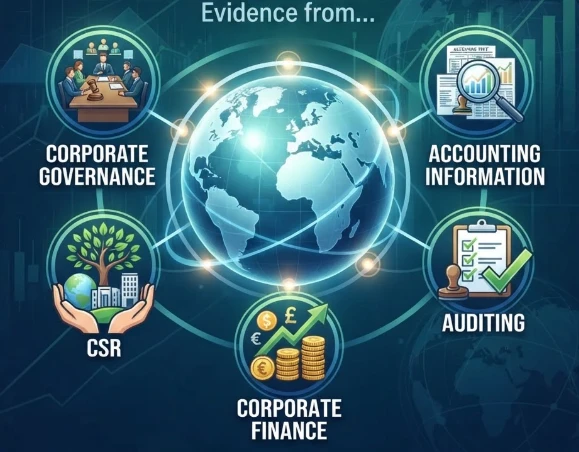
Corporate governance makes it possible to decide which aspect of transparency is truly supervision and which is simply a form of communication. Boards should be made more responsible for tax risk, be provided with escalation procedures for unclear positions, and receive information that links tax planning with strategy and reputation. Audit committees may conduct tests of whether disclosures are accurate with respect to accounting records and whether aggressive structures pose risks that are inconsistent with the disclosures. Good governance is also able to distinguish between legitimate use of incentives and opaque, artificial separation or assumptions that are unlikely to pass regulatory muster.
Sustainability reporting offers a more comprehensive reporting framework. The two IFRS standards published in 2023 (IFRS S1 and IFRS S2) provide a framework that groups sustainability-related financial information into four categories: governance, strategy, risk management, metrics and targets, and differentiates physical risks from transition risks in IFRS S2. The standards are based on information about enterprise prospects and not all social impacts. The sustainability strategy communicated to capital providers could be complemented by tax transparency, which reflects the relationship between public incentives, geographic profit distribution and tax governance.
Corporate communication brings opportunity and risk. Explain the reasons for the differences in effective and statutory tax rates, how losses and timing differences influence current tax and how incentives influence investment. When lacking in evidence, vague assertions of responsibility for tax can have adverse consequences. Readers should be provided with sufficient detail to identify structural features from discretionary planning. An annual report, sustainability report, country disclosure report, investor presentation and disclosure to regulators will all be more convincing if they are consistent rather than conflicting.
However, social enterprises have a mission-accountability issue where commercial growth and social benefit do not go hand-in-hand. Revenue growth and lessening access to disadvantaged groups is possible, and high impact does not have to be achieved through rapid financial scaling. The integration of outcomes and beneficiaries, contribution and risk with financial and tax information is most effective when it comes to social-impact reporting. The transparency of fiscal support allows investors to make an assessment of the model's self-sustaining nature or reliance on ongoing fiscal support.
The additional standard is the one you find in impact investing that explicitly addresses the financing of an impact—the social and/or environmental impact—alongside the financial return. Impacts are becoming more focussed on objectives, indicators, baselines, contribution and risk of shortfall, and are not just being treated as evidence in itself. The issue of taxation arises here as subsidies, exemptions, and even credits can affect reported returns. Clear reporting of market performance and the addition of value by public fiscal measures.
There's a similar issue for social enterprises. Ordinary profit figures are a poor indicator of performance as they can include a mix of trading profits, grants, concessionary capital and tax preferences. Social-impact reporting can help to explain who benefits, what is happening, and how to measure results, but metrics must have a credible baseline with consistent boundaries. The stronger the financials, the tax treatment, and the impact indicators, the more public-benefit claims there are. It's not the right time to be adding another "X" or "Y" to those records.
While the SDGs offer a common language, vague shared SDG claims can lead to vacuous language. Good practice is the ability to identify specific targets, measurable indicators and the mechanism linking activity to outcome. Tax transparency belongs to that discipline, since it uses fiscal incentives as public resources - and opportunity costs. A company that benefits from a concession can tell you what investment or employment they have created, and what the policy objective was for that support.Governments can report the revenue lost, and the policy goal that also was supported with that concession.
Another significant nexus between sustainability and corporate responsibility and public finance is public procurement. Procurement is significant in terms of economic activity in member economies, as evidenced by the OECD, and can have a significant impact on environmental outcomes, labour standards, integrity and innovation through purchasing rules. While they can incentivise responsible supply, poorly-crafted sustainability clauses can lead to less competition or to being a box ticking exercise. The use of ESG language must be backed by clear tender criteria, concrete evidence and contract monitoring.
The contractual complexity of public-private partnerships is increased over the long term. Infrastructure contracts can last decades and include construction, financing, service and guarantees as well as risk transfer. Sustainability needs to be incorporated into measurable standards rather than being aspirations. Transparency about contingent liabilities, tax assumptions, procurement decisions and performance indicators is conducive to accountability. A project can look cheap at signing, without that information, and put a significant burden on the public balance sheet to take that risk.
Let's see how workplace diversity demonstrates the importance of being careful in interpreting social disclosure. Recruitment, promotion, compensation, retention, safety or leadership access can be gleaned from headcounts only in a very limited way. Effective reporting is vital to matching representation with employment outcomes, governance processes and to safeguarding legitimate privacy interests. Tax breaks for jobs or training should also be evaluated on a similar basis when they are based on conditions of employment or training. When workforce claims are backed by measurable results and the financial backing that comes with those results is evident, there's more credibility in corporate responsibility.
For credible transparency, comparability and assurance are essential, as is consequence. Needs stable definitions of metrics, explanation of reported range, etc., for major changes across periods. Independent assurance can help to build confidence but confidence cannot compensate for a misnarrated strategy. Reporting systems should also be in place for public agencies to report tax expenditures, procurement commitments, and corporate disclosures on a comparable basis, to the extent possible. Transparency is a tool to create public value by influencing decisions, revealing inconsistencies, holding others to account, and not just by generating additional published information.
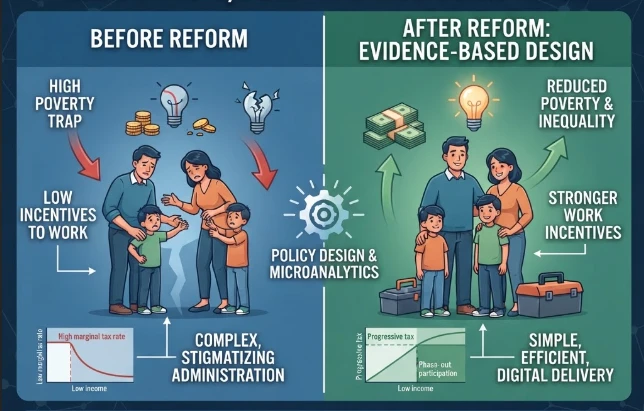
This integrated perspective helps mitigate the chance of a technically sound rule having poor results in the presence of real incentives for households, firms and administrators. The more analytical method is to test the statutory design against the incentives observed, capacity of administration, and distributional impacts, without relying on labels.
CITE THIS ARTICLE
Sultana, K. R. (2025). Tax Transparency as Corporate Social Responsibility: Evidence from Impact investing, social enterprises, SDGs, impact measurement, social-impact reporting. https://researchbysultana.com/article/79d6e114-2614-58aa-8715-7dc427cf8d64
K. R. Sultana, “Tax Transparency as Corporate Social Responsibility: Evidence from Impact investing, social enterprises, SDGs, impact measurement, social-impact reporting,” 2025. [Online]. Available: https://researchbysultana.com/article/79d6e114-2614-58aa-8715-7dc427cf8d64
Sultana, K. R. (2025) ‘Tax Transparency as Corporate Social Responsibility: Evidence from Impact investing, social enterprises, SDGs, impact measurement, social-impact reporting’. Available at: https://researchbysultana.com/article/79d6e114-2614-58aa-8715-7dc427cf8d64
Sultana, Kazi Rukaiya. “Tax Transparency as Corporate Social Responsibility: Evidence from Impact investing, social enterprises, SDGs, impact measurement, social-impact reporting.” 2025, https://researchbysultana.com/article/79d6e114-2614-58aa-8715-7dc427cf8d64.
Kazi Rukaiya Sultana. “Tax Transparency as Corporate Social Responsibility: Evidence from Impact investing, social enterprises, SDGs, impact measurement, social-impact reporting.” (2025). https://researchbysultana.com/article/79d6e114-2614-58aa-8715-7dc427cf8d64.
Sultana KR. Tax Transparency as Corporate Social Responsibility: Evidence from Impact investing, social enterprises, SDGs, impact measurement, social-impact reporting. 2025. https://researchbysultana.com/article/79d6e114-2614-58aa-8715-7dc427cf8d64
@misc{article_79d6e114261458aa87157dc427cf8d64,
  title = {Tax Transparency as Corporate Social Responsibility: Evidence from Impact investing, social enterprises, SDGs, impact measurement, social-impact reporting},
  author = {Kazi Rukaiya Sultana},
  year = {2025},
  url = {https://researchbysultana.com/article/79d6e114-2614-58aa-8715-7dc427cf8d64},
}
TY  - GEN
AU  - Kazi Rukaiya Sultana
TI  - Tax Transparency as Corporate Social Responsibility: Evidence from Impact investing, social enterprises, SDGs, impact measurement, social-impact reporting
PY  - 2025-09-28
UR  - https://researchbysultana.com/article/79d6e114-2614-58aa-8715-7dc427cf8d64
ER  -
This article uses institutional economics and applied microeconomics to show why tax-transfer reform cannot be evaluated from policy rules alone. Household disposable income reflects earnings, taxes, contributions, benefits, housing support and withdrawal schedules, but the effectiveness of those rules also depends on institutions that administer them. Different data systems, delayed appeals, inconsistent local delivery and administrative capacity can cause a theoretically efficient policy to wo
This article presents tax transparency as a governance and accounting issue rather than a simple disclosure exercise. Boards oversee tax outcomes that are influenced by risk appetite, capital allocation, internal controls, remuneration and significant transactions, while accounting systems provide the common record connecting financial profit, taxable income, deferred tax, cash tax and uncertain positions. IFRS S1 and IFRS S2 are used to show how sustainability-related financial information can
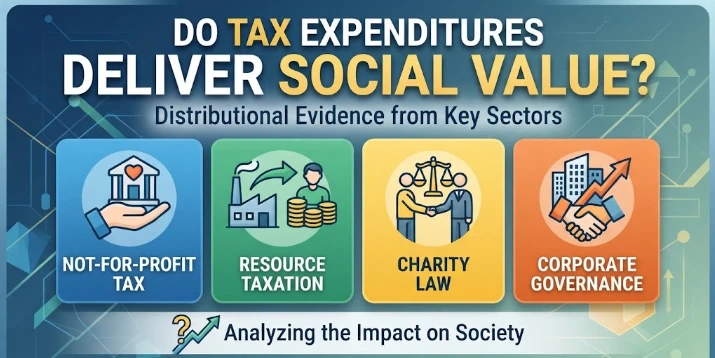
This article evaluates tax expenditures in not-for-profit, charity and resource-tax settings through distribution, governance and public value. Preferential treatment for charities and similar organisations is justified by public or community benefit, so reporting and governance should show whether concessions expand valued services, improve access or instead accumulate as private or organisational advantage. The article warns that annual income alone is an incomplete equity measure because life