Tax Transparency as Corporate Social Responsibility: Evidence from Accounting, public sector accountability, taxation law/policy-adjacent research, public
Kazi Rukaiya Sultana (Master of Public Policy & Master of Social Welfare and Research)
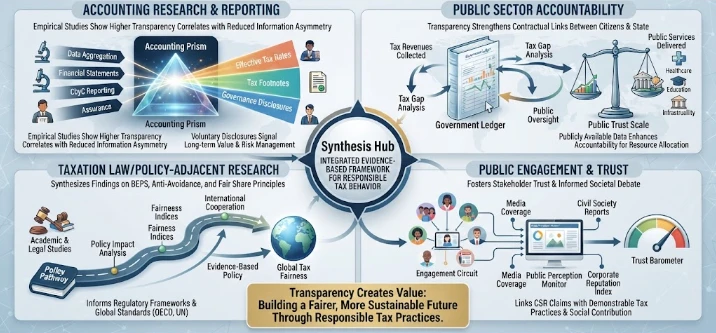
This article examines tax transparency as a component of corporate social responsibility, accounting and public-sector accountability. Financial statements disclose current tax, deferred tax, effective rates and uncertain positions, but those figures do not always correspond directly with cash tax paid in each jurisdiction. The article therefore argues that transparency should provide context for differences caused by losses, depreciation, incentives, timing and group structures. Country-by-country reporting under the BEPS framework and GRI 207 are presented as important mechanisms for improving information about tax strategy, governance and geographic activity. The CSR connection comes from the role of tax revenue in financing infrastructure, health, education and other public institutions. At the same time, governments are expected to explain tax incentives, tax expenditures and enforcement so that accountability is not one-sided. Board and audit-committee oversight, internal controls and data reconciliation are central to credible disclosure. The article also stresses that transparency cannot replace substantive tax law or audit. The strongest model combines accurate accounting, contextual public reporting, corporate governance and government explanation of the fiscal rules shaping corporate tax outcomes.
Transparency in taxation is one of the most evident overlaps in accounting, corporate responsibility and public accountability. Tax returns are usually confidential, and confidentiality is crucial for proper administration. But big corporations also depend on public infrastructure, the legal system, trained labour, financial markets, and government services. Evolving demands from stakeholders raise questions about the quality of information in the published financial statements to understand corporate tax contribution and risk. In April 2026, tax transparency thus is not just a technical reporting problem, but a broader discussion on corporate social responsibility and fiscal legitimacy.
The first level of evidence comes from accounting. Financial statements include and disclose current tax expense, deferred tax, effective tax rates, uncertain positions and reconcile accounting profit and tax expense for applicable tax standards. Those are significant numbers but not cash tax revenues collected in a jurisdiction. There are many reasons for large differences between accounting tax expense and current payments, including timing differences, losses and depreciation, tax credits, group structures, and recognition rules. The only numbers people can be certain of when interpreting public statements are when they are used as indicators of avoidance or good citizenship.
Tax transparency aims to put some perspective on it. The BEPS Action 13 framework of the Organisation for Economic Co-operation and Development (OECD) will force large multinational groups to report to tax authorities on a country-by-country basis, disclosing revenue, profit, tax, employees and tangible assets by country. It's not about public reputation management; it's about high-level risk assessment. That confidential reporting has come along on the same lines as public reporting. The GRI 207: Tax (2021) was released as a new global sustainability reporting standard that focuses on the public country-by-country disclosure of tax strategy, governance, stakeholder engagement, and other related tax matters.
The CSR linkage arises from the role of tax in society. Corporate tax revenues go into public funds that are used for education, health, infrastructure, courts, the provision of environments, regulations, and social programmes. Tax governance can therefore be viewed as a broader impact that is leveraged through business activities.
It is not necessarily the best responsible tax payment, the biggest. Legislated deductions and incentives can have legitimate policy purposes. Responsible behaviour is not about giving money away, it's about compliance, substance, governance, consistency and explanation.
That creates a matching accountability in the public sector. Governments which require the enhanced transparency of corporations should clarify how tax rules, incentives, settlements, and enforcement work. Tax expenditures can lower corporate tax bills and not be as apparent as spending. Effective tax rates can be significantly affected by investment incentives, accelerated allowances, research credits or even sector concessions. Governments should report their fiscal costs and policy goals and allow the assessment of a low corporate tax outcome to be evaluated in the context of the rules that led to the outcomes against which they should not be compared to an assumed outcome.
Australia offers a good example of tax reporting by the government. Large companies that meet statutory thresholds provide entity level information which is published by the Australian Taxation Office to assist in discussion of corporate tax results. Even more staggering is the fact that these reports have been used to illustrate not only the brevity of reporting massive aggregate payments made by the big boys, but also the fact that some entities have been able to report accounting income without taxable income or tax payable.
The meaning is dependent on context. Tax losses, deductions, capital investment, timing and group arrangements can be valid and some results can still be targeted for compliance focus. Questions arise and are answered by transparency, audit and analysis.
This separation allows tax transparency to not be tax theatre. A company can put out a glossy tax principles, but not enough data to test those claim. Activists, on the other hand, or commentators, can cite one bad tax year and say that a politician's not doing his job well.
Improved reporting puts strategy in the numbers and numbers in the economic substance. Explanation is important where a group has significant profit in a jurisdiction which has relatively little number of employees or tangible assets. Public should be aware of the relationship between low tax and a legislated investment incentive.
Governance is the linkage between disclosure and conduct. Boards and audit committees should review and supervise material tax risks, large and complex cross-border transactions, transfer pricing programs, uncertain tax positions, and public disclosure. A paper tax strategy that allows for the effective tax rate to be aggressively lowered (no matter the risk) is of little value. Internal control should establish responsibilities, threshold limits, documentation requirements, escalation procedures and consistency procedures. Tax transparency is credible when public claims are based on controls that have an impact on decisions.
There needs to be support for jurisdictional reporting in accounting systems as well. Financial data is typically gathered in various systems by multinational groups for various purposes, including consolidation, tax compliance, management reporting and sustainability reporting. Definitions might differ from one of those purposes to another.
Consolidated revenue and revenue in a country-by-country report are not necessarily the same. Also, accrual of taxes differs from cash paid of taxes. Reconciling and ownership of information is a critical part of strong data governance. If this discipline isn't practiced, transparency can lead to conflicting data and thus erode trust.
The evaluation of the effect of disclosure rules is a function of public sector research. Some of the key questions are: Does tax transparency change the corporate behaviour? Does it enhance enforcement? Does it reduce profit shifting? Does it shift investment? Does it impact public trust? Also, compliance cost and data quality should be researched. Additional disclosure is not necessarily beneficial when the user is unable to read it. A good regime should bring similar data, sufficient narration and consistency over time.
The principle of confidentiality is a key boundary. Information needs of tax administration should not be disseminated automatically and requires detailed information. Commercial sensitive information, personal information and Audit material may necessitate legal protection. There must be a multi-layered approach to public accountability—confidential reporting at the administrative level, public reporting at the standardised level, and financial-statement reporting at the investor level. The layers are not the same and are used for different purposes.
Tax policy also affects what transparency can accomplish. Disclosure won't fix the revenue system if there are significant loopholes, inconsistent bases or incentives that aren't well designed into the legislation. Patterns can be identified with public country-by-country information, but taxable liability is determined by the rules of law. Anti-avoidance, transfer pricing standards, treatment rules, administration and dispute resolution are still needed. Transparency is a tool of accountability, not of tax policy.
When disclosure is not selective, it is the strongest form of corporate responsibility. A group should discuss the differences between accounting profit, taxable income, current tax expense and cash tax paid. Describe important incentives or losses clearly, and provide context if there are important changes from year to year. Jurisdictional reporting may reveal areas of congruency and discrepancy among employees, assets, revenue, profit and tax. This explanation enables stakeholders to evaluate tax behaviour without making any assumptions that all differences are suspicious.
Government communication should be on a similar level. There are measures public authorities can take to explain the rationale behind large-scale tax incentives, to publish the aggregate revenue cost, to report estimates of the volume of tax gaps, and to describe the compliance strategies. Transparent public administration contributes to the creation of a two-way accountability process as opposed to a single one-way demand. Both taxpayers and government can be measured against principles and trust is strengthened.
Tax transparency is an integral part of responsible corporate governance, and its usefulness relies on interpretation and design of the institutions. Numbers are provided by accounting, context by public reporting, liability by tax law and compliance by revenue administration. The ability of CSR to address the deeper issue of whether or not corporate tax behaviour is consistent with their social commitments.
Public-sector accountability rounds out the picture by calling for explanation of the incentives and enforcement in the public sector. The best system of transparency in today's world is not a tax ratio. This establishes a clear and traceable economic activity-to-accounting-to-tax-to-institution-building-trust-long-term evidence chain, accounting-to-tax-to-public-contribution-to-governance-to-fiscal-cost-to-durable-and-measurable-long-term-trust-in-institutions.
CITE THIS ARTICLE
Sultana, K. R. (2026). Tax Transparency as Corporate Social Responsibility: Evidence from Accounting, public sector accountability, taxation law/policy-adjacent research, public. https://researchbysultana.com/article/66fdf943-13ca-5466-94a6-c74d40d83764
K. R. Sultana, “Tax Transparency as Corporate Social Responsibility: Evidence from Accounting, public sector accountability, taxation law/policy-adjacent research, public,” 2026. [Online]. Available: https://researchbysultana.com/article/66fdf943-13ca-5466-94a6-c74d40d83764
Sultana, K. R. (2026) ‘Tax Transparency as Corporate Social Responsibility: Evidence from Accounting, public sector accountability, taxation law/policy-adjacent research, public’. Available at: https://researchbysultana.com/article/66fdf943-13ca-5466-94a6-c74d40d83764
Sultana, Kazi Rukaiya. “Tax Transparency as Corporate Social Responsibility: Evidence from Accounting, public sector accountability, taxation law/policy-adjacent research, public.” 2026, https://researchbysultana.com/article/66fdf943-13ca-5466-94a6-c74d40d83764.
Kazi Rukaiya Sultana. “Tax Transparency as Corporate Social Responsibility: Evidence from Accounting, public sector accountability, taxation law/policy-adjacent research, public.” (2026). https://researchbysultana.com/article/66fdf943-13ca-5466-94a6-c74d40d83764.
Sultana KR. Tax Transparency as Corporate Social Responsibility: Evidence from Accounting, public sector accountability, taxation law/policy-adjacent research, public. 2026. https://researchbysultana.com/article/66fdf943-13ca-5466-94a6-c74d40d83764
@misc{article_66fdf94313ca546694a6c74d40d83764,
  title = {Tax Transparency as Corporate Social Responsibility: Evidence from Accounting, public sector accountability, taxation law/policy-adjacent research, public},
  author = {Kazi Rukaiya Sultana},
  year = {2026},
  url = {https://researchbysultana.com/article/66fdf943-13ca-5466-94a6-c74d40d83764},
}
TY  - GEN
AU  - Kazi Rukaiya Sultana
TI  - Tax Transparency as Corporate Social Responsibility: Evidence from Accounting, public sector accountability, taxation law/policy-adjacent research, public
PY  - 2026-04-26
UR  - https://researchbysultana.com/article/66fdf943-13ca-5466-94a6-c74d40d83764
ER  -
This article uses institutional economics and applied microeconomics to show why tax-transfer reform cannot be evaluated from policy rules alone. Household disposable income reflects earnings, taxes, contributions, benefits, housing support and withdrawal schedules, but the effectiveness of those rules also depends on institutions that administer them. Different data systems, delayed appeals, inconsistent local delivery and administrative capacity can cause a theoretically efficient policy to wo
This article presents tax transparency as a governance and accounting issue rather than a simple disclosure exercise. Boards oversee tax outcomes that are influenced by risk appetite, capital allocation, internal controls, remuneration and significant transactions, while accounting systems provide the common record connecting financial profit, taxable income, deferred tax, cash tax and uncertain positions. IFRS S1 and IFRS S2 are used to show how sustainability-related financial information can
This article evaluates tax expenditures in not-for-profit, charity and resource-tax settings through distribution, governance and public value. Preferential treatment for charities and similar organisations is justified by public or community benefit, so reporting and governance should show whether concessions expand valued services, improve access or instead accumulate as private or organisational advantage. The article warns that annual income alone is an incomplete equity measure because life