Climate Risk, Tax Incentives, and Corporate Accountability: Evidence from Carbon Taxation, Green Investment Incentives, Climate Disclosure, and Transition Finance
Kazi Rukaiya Sultana (Master of Public Policy & Master of Social Welfare and Research)
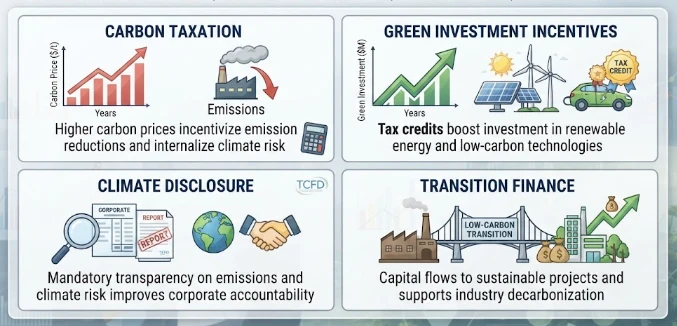
This article compares carbon taxation, green investment incentives, climate disclosure and transition finance as tools for managing climate risk. Carbon pricing raises the cost of emissions across covered activities, while credits and accelerated deductions reduce the cost of specified low-carbon investments. Each instrument can change behaviour, but both may also create windfalls if policy does not test additionality, technology maturity and interaction with existing regulation. The article argues that climate-tax incentives should include review points and exit strategies because technology costs, market penetration and carbon prices change over time. Refundability, carry-forward rules, investment thresholds and grant interactions determine which firms can actually use incentives. IFRS S1 and IFRS S2 strengthen the information environment by structuring disclosures around governance, strategy, risk management, metrics and targets. Social and environmental accounting add evidence on emissions, workforce, community and biodiversity impacts that ordinary profit measures may not capture. Transition finance introduces further questions about risk sharing and public support. Credible climate accountability requires consistent links among fiscal incentives, corporate disclosures, investment decisions, financing structures and measurable environmental outcomes.
Climate risk has emerged as a fiscal and corporate-governance problem because of the potential for changes in the value of assets, operating expenses, insurance costs, supply chains and public budgets. Floods, heat, storms, droughts and wildfire damage impose direct damages but decarbonisation policy changes prices relative to energy, transport, buildings and industry. There are three mechanisms within that adjustment: carbon pricing, investment allowances, excise design, accelerated depreciation, and targeted credits. A credible framework is thus a link between climate economics and tax incidence and accountability, and not a set of environmental incentives and incentives that are merely given out in isolation.
There are several differences between carbon taxation and green investment incentives with respect to inducing behavioural change. The carbon price increases the cost of emissions for all covered emissions, thereby providing a general incentive to lower the carbon intensity of emissions; tax credits or accelerated deductions reduce the cost of covered investments. Either can be used to overcome financing constraints or technology spillovers, and the joint use of the two can generate windfalls as well. When evaluating policy, there will be additional emissions reductions, costs to the fiscal budget, technology maturity requirements, distribution and interaction with existing policy that will have to be included.
A well-designed climate-tax policy should, therefore, have an exit strategy. The costs of technology change over time, as does their penetration of the market, carbon prices and regulation – an incentive that may be valid at the time of introduction may become redundant or distortive at a later stage. Clauses to change rates or eligibility prior to fiscal cost becoming politically ingrained, via sunset and scheduled evaluation. The choice of instrument is not based on tax-preference but on what barriers the instrument is best suited to address.
Environmental tax incentives may be effective in speeding up investment if they respond to a clear market failure and if the activity they can support is sufficiently precisely defined so that windfalls will be minimized. The incentives can be poorly designed and reward projects that are already commercially viable, incentivize relabelling, and incentivize firms with a better tax capacity than the firms providing the greatest environmental benefit. Real access is influenced by refundability, carry-forward rules, investment thresholds and interaction with grants. Evaluation should be conducted on a scorecard that has additionality, emissions results, distributional impacts, fiscal costs and administrative complexity.
The availability and quality of sustainability information is increasingly a key determinant for corporate accountability. IFRS S1 and IFRS S2 were released in 2023, and start to apply to annual reporting periods from 2024, and they group disclosure into a few categories: governance, strategy, risk management, metrics, and targets. The architecture is important for tax policy as claimed green investment incentive becomes easier to be targeted if the capital expenditure, transition plans and climate exposures are reported in a consistent manner.
Social and environmental accounting is an analysis that goes beyond the traditional notion of profit. The economic impacts of energy use, emissions, impacts on the workforce, on communities, on biodiversity and remediation requirements are only indirectly expressed in ordinary economic ratios. Environmental accounting is not an alternative to financial accounting; it provides extra data to assess if the level of reported performance is associated with external costs which are not priced. Information-compatible tax incentives may help to improve the allocation of capital, but market-incompatible tax incentives may become a branding subsidy in terms of weak measurement.
Climate disclosure makes transition exposure and capital plans more visible, enhancing that assessment. The IFRS S2 (2023) is a guidance for entities using it, mandating material information regarding governance, strategy, risk management, metrics and targets related to climate change. These disclosures might enable investors to consider whether a green project is an addition to their carbon intensive portfolio or if it is altering its business model. Tax authorities are still looking for eligibility evidence, but uniform climate information is a step closer to fiscal claims and corporate strategy.
An important caveat from critical accounting theory is with regard to power and framing. Choices regarding materiality, boundaries, baselines, and metrics have an impact on what is visible in disclosure systems, so that choices regarding the materiality, boundaries, baselines, and metrics do not generate neutral facts. A business might say it has cut its operational emissions, yet its supply-chain emissions go up – or a small green business might say it has a small green portfolio while a bigger, high-carbon business remains unchanged. Fiscal authorities thus require definitions which are not linked to promotional discourses and which are verifiable in the light of the tax records, engineering evidence or recognised reporting criteria.
Another way to think of the public-finance question is to consider average annual expenditures, as opposed to tail risk, in the context of climate and disaster economics. At the same time, in the event of a severe occurrence, there is a risk of tax revenues being squeezed and emergency spending, reconstruction, health and social protection spending increasing. Disaster risk financing is the process of providing liquidity in the aftermath of shocks with tools like reserves, contingent credit, insurance, catastrophe cover and budget reallocation. The goal is not only for relief, but to avoid disruptive fiscal adjustment if there is a sudden decrease in ordinary revenue.
The importance of distribution is due to the fact that climate policy or climate shocks are not universally distributed and broad-based. Lower income households may be more likely to be spending a higher percentage of their current income on energy costs, while higher income households may have more resources to put toward efficient vehicles, insulation or rooftop generation or other eligible investments. Those imbalances can be mitigated through targeted transfers and refundable credits, and public investments. The house-hold budget after taxes, prices and compensation should be used in incidence analysis not an instrument's environmental label alone.
Decisions made in public investment must be made similarly. While resilient infrastructure can be more expensive to build, it can help minimize expected losses, disruption of services, and reconstruction costs throughout an asset's life. That value is understated when disaster probability or network effects and distributional consequences are not included in a conventional appraisal. The ability of finance ministries to compare prevention vs. repeated repair is enhanced with the climate-adjusted cost-benefit analysis. The use of transparent assumptions is still important as hazards projections and discount rates can have a significant impact on the outcomes.
The additional challenge of transition finance is that in high-emission sectors, financial resources are required to be able to decarbonise and not just finance their exclusion from finance. Fiscal risk is higher for larger projects in public guarantees, concessional lending, tax incentives or blended structures where government absorbs the downside but has no measurable transition obligations. Clear linkage between financing terms and milestones, emissions, disclosure and claw-back/review mechanisms. Three elements are essential to a successful climate policy: clear climate transition path, financial governance and investment support, and carbon signals.
A layer of accountability is added with Climate Finance as it shifts some of the risk from the taxpayer to the private investor through public guarantees, concessional lendings, blended finance, and tax incentives. It can open projects, which have big social benefits, but in the case of weak contracts, downside risk will be socialised, while most of the upside will remain private. Fiscal control is enhanced by the adequate fulfillment of additionality tests, the achievement of performance targets, clawback requirements and disclosure of contingent liabilities. Explicit risk sharing is the best way to get public support.
Evaluation of firm performance should take into account transition costs as well as resilience benefits over a time horizon sufficiently long to reflect such costs and benefits. Early investment in the environment may decrease energy expenses, regulatory risks, or disruption risks; however, environmental investments may lead to a decline in short-run accounting return. A narrow one-year profitability test can thus be a negative for investments with long-lasting value. In parallel, not all environmental projects are smart in terms of competitiveness, and claims must be substantiated with evidence of productivity and/or operating cost, revenue quality and financing conditions, and risk reduction, and not in general terms in the sustainability context.
The administration of taxes is also important with regard to green incentives. Technical features, like equipment type, emissions intensity, project timing or certification, determine eligibility. Revenue agencies require knowledge and information that goes far beyond what's found in the books, and companies must have rules relating to documentation before they invest. There are measures which can help to ease the uncertainty, including pre-approval, standardised certificates, information sharing with sector regulators, and post-claim verification. When the qualifying conditions are closely aligned to measurable outcomes, their integrity can be maintained while at the same time they can be made easier to take up.
Consistency in tax documentation, financial statements, sustainability reporting, investment decisions, and environmental impacts is a robust accountability test. Any firm that says it is leader in climate change and uses unclear incentives or inadequate measurement is running the risk of credibility and a government that encourages investment in green projects but doesn't disclose fiscal costs is in the same boat. There are clear links between environmental ambitions and concrete figures, distributional analysis, public-budget discipline in strong policy. That can make climate taxing a tangible element of economic transition strategies.
CITE THIS ARTICLE
Sultana, K. R. (2025). Climate Risk, Tax Incentives, and Corporate Accountability: Evidence from Carbon Taxation, Green Investment Incentives, Climate Disclosure, and Transition Finance. https://researchbysultana.com/article/41e20afa-5db5-529e-a570-e3a1978ac74a
K. R. Sultana, “Climate Risk, Tax Incentives, and Corporate Accountability: Evidence from Carbon Taxation, Green Investment Incentives, Climate Disclosure, and Transition Finance,” 2025. [Online]. Available: https://researchbysultana.com/article/41e20afa-5db5-529e-a570-e3a1978ac74a
Sultana, K. R. (2025) ‘Climate Risk, Tax Incentives, and Corporate Accountability: Evidence from Carbon Taxation, Green Investment Incentives, Climate Disclosure, and Transition Finance’. Available at: https://researchbysultana.com/article/41e20afa-5db5-529e-a570-e3a1978ac74a
Sultana, Kazi Rukaiya. “Climate Risk, Tax Incentives, and Corporate Accountability: Evidence from Carbon Taxation, Green Investment Incentives, Climate Disclosure, and Transition Finance.” 2025, https://researchbysultana.com/article/41e20afa-5db5-529e-a570-e3a1978ac74a.
Kazi Rukaiya Sultana. “Climate Risk, Tax Incentives, and Corporate Accountability: Evidence from Carbon Taxation, Green Investment Incentives, Climate Disclosure, and Transition Finance.” (2025). https://researchbysultana.com/article/41e20afa-5db5-529e-a570-e3a1978ac74a.
Sultana KR. Climate Risk, Tax Incentives, and Corporate Accountability: Evidence from Carbon Taxation, Green Investment Incentives, Climate Disclosure, and Transition Finance. 2025. https://researchbysultana.com/article/41e20afa-5db5-529e-a570-e3a1978ac74a
@misc{article_41e20afa5db5529ea570e3a1978ac74a,
  title = {Climate Risk, Tax Incentives, and Corporate Accountability: Evidence from Carbon Taxation, Green Investment Incentives, Climate Disclosure, and Transition Finance},
  author = {Kazi Rukaiya Sultana},
  year = {2025},
  url = {https://researchbysultana.com/article/41e20afa-5db5-529e-a570-e3a1978ac74a},
}
TY  - GEN
AU  - Kazi Rukaiya Sultana
TI  - Climate Risk, Tax Incentives, and Corporate Accountability: Evidence from Carbon Taxation, Green Investment Incentives, Climate Disclosure, and Transition Finance
PY  - 2025-02-16
UR  - https://researchbysultana.com/article/41e20afa-5db5-529e-a570-e3a1978ac74a
ER  -
This article uses institutional economics and applied microeconomics to show why tax-transfer reform cannot be evaluated from policy rules alone. Household disposable income reflects earnings, taxes, contributions, benefits, housing support and withdrawal schedules, but the effectiveness of those rules also depends on institutions that administer them. Different data systems, delayed appeals, inconsistent local delivery and administrative capacity can cause a theoretically efficient policy to wo
This article presents tax transparency as a governance and accounting issue rather than a simple disclosure exercise. Boards oversee tax outcomes that are influenced by risk appetite, capital allocation, internal controls, remuneration and significant transactions, while accounting systems provide the common record connecting financial profit, taxable income, deferred tax, cash tax and uncertain positions. IFRS S1 and IFRS S2 are used to show how sustainability-related financial information can
This article evaluates tax expenditures in not-for-profit, charity and resource-tax settings through distribution, governance and public value. Preferential treatment for charities and similar organisations is justified by public or community benefit, so reporting and governance should show whether concessions expand valued services, improve access or instead accumulate as private or organisational advantage. The article warns that annual income alone is an incomplete equity measure because life