Tax-Transfer Reform, Poverty Reduction, and Work Incentives: Evidence from Tax progressivity, consumption, income tax reforms, lifetime inequality, welfare
Kazi Rukaiya Sultana (Master of Public Policy & Master of Social Welfare and Research)
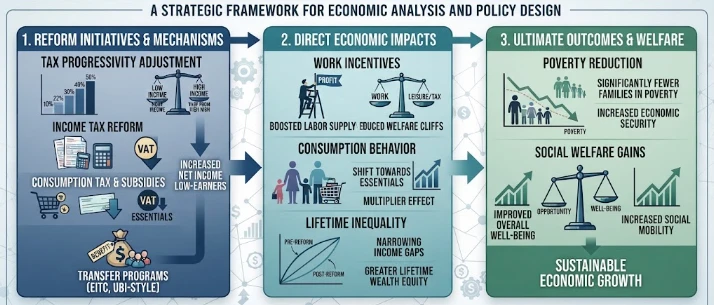
The article argues that tax progressivity should be assessed across the entire fiscal system and over time, not from one annual tax table. Income changes through education, career progression, unemployment, family formation and retirement, so annual inequality can differ substantially from lifetime inequality. Consumption also matters because lower-income households often spend a larger share of current income, making broad consumption taxes appear regressive even when they are administratively efficient. Targeted transfers can offset some of that burden if take-up and delivery are reliable. The article links mobility, welfare and human capital, noting that transfers supporting housing, nutrition, childcare or education may improve future earnings even when they create short-run fiscal costs. Administrative design influences outcomes through forms, reassessments, reconciliation, debt recovery and digital accessibility. Microsimulation can show distributional patterns, effective marginal tax rates and interactions between taxes and benefits by family type. Gradual tapers can preserve work incentives without abrupt loss of support. Sustainable reform therefore requires both annual and lifetime perspectives, transparent assumptions, behavioural sensitivity analysis and fiscal scenarios before policy rules become entrenched.
Tax-transfer policy is not just about tax rates but about the disposable income. Household income, income tax, social contributions, cash benefits, housing support, family payments and withdrawal rules are all part of one household budget. Even a modest gain following another payment can be obtained with a reform that reduces one tax rate. The object to consider, in the case of poverty and work incentives, is then the full budget constraint of a household at various income levels.
Annual inequality may differ from lifetime inequality because of changes in income over time due to education, career advancement, retirement, and unemployment as well as family formation. So, an increasing annual tax rate can have varying lifetime impacts on households with non-permanent and permanent incomes. Consumption patterns are also important as lower income groups tend to consume a higher proportion of their current income. An annual distribution table cannot be used as an assessment of a complete reform, because it fails to consider income, consumption, wealth, and age.
The importance of mobility is that households experience income fluctuations over time. Low income is temporary when it is due to study, caregiving, unemployment, business fluctuations or early in one's career, but low income is persistent when it is a different type of policy challenge. It is important to recognise that modelling the incidence of taxes at one point in time can pick up immediate incidence but not all lifetime incidence. Longitudinal evidence helps to clarify the impact of support on whether temporary shocks are smoothed over, persistent poverty is reduced or opportunities for upward mobility are shifted.
The other link between welfare design and long-run productivity is human capital. Transfers that provide nutrition, housing stability, access to child care or educational participation can help to improve future earnings, even if they appear to be a cost in the short run fiscal accounts. On the other hand, benefit rules that disincentive training incomes or leave benefit uncertainty about study can deter skill investment. A serious work incentive regime e.g. must not only focus on the current supply of labour but also on whether existing rules boost future earning potential.
Public economics also cautions that all behavioural reactions are not socially desirable. If the supply of formal labour is increased due to a tax change, it can affect unpaid care within the household, demand for childcare, or can have an interaction effect with market power. Further complicating a two-sided market is that a tax levied on a platform or provider may impact both sides of a transaction. Incidence involves elasticities and market structure, rather than just the who has the name of the taxpayer in the law.
The distributional conflict is easily illustrated by consumption taxes. The efficient collection of revenue through broad consumption taxes may be associated with reduced spending of current income among the less well-off. Lower rates on necessities can ease the burden and can yield high absolute gains to households with high expenditure on necessities. When administrative systems serve as effective and consistent indicators of eligibility and rules for payments are easily understood, targeted transfers can compensate for regressivity more directly.
Progressivity needs to be measured throughout the whole fiscal system. Personal income tax can be progressive, but consumption taxes, payroll contributions, housing subsidies and benefit withdrawal can change the final pattern. The value of tracking taxes and benefits through household income is illustrated by new New Zealand fiscal-incidence work that looks at the incidence of these instruments together. Such analysis can show if an apparent reform will make a difference to lifetime inequality, to annual inequality, or to neither.
Some regressive consumption-tax effects can be mitigated with a targeted cash transfer. That way, it maintains a large tax base while targeting those households with the highest budget pressures. However, to be successful, take-up, payment timeliness and income reporting need to be accurate. Delays in, or administrative barriers to, access to a theoretically well-targeted transfer provide little protection for eligible households.
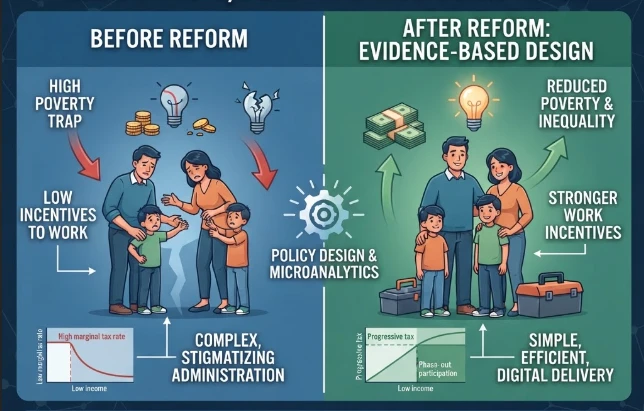
The administrative design matters just as much as statutory generosity. Reconciliation, forms and procedures can be complex and time-consuming and may be hard on the take-up or introduce hardship. While automatic data matching and pre-populated information can make it easier to access, digital systems must also have ways for those who encounter language, disability, connectivity and record-keeping challenges. A reform has to have welfare effects if households that are eligible for help are able to access or understand it.
Sustainable fiscality is still taken into account in the equity calculation. The ongoing deficits in transfers can cause the costs of this deficit to be passed on to future generations; failing to target tax cuts correctly can decrease the revenue required for high-cost services. Sustainable reform specifies a steady source of funding and sets out distributional decisions. This strategy enables poverty reduction, incentives and public-service funding to be seen as interrelated goals, not as competing slogans.
Averages have become a central element of that analysis in part due to the introduction of microsimulation.The introduction of microsimulation has been central to that analysis because of the use of averages that mask people whose lives are influenced by interacting rules. The New Zealand Treasury's TAWA model is built on representative microdata, and has been used for distributional, fiscal-incidence and effective-marginal-rate analysis. Tax-and-spending microsimulation is also common in advanced administrations as revealed by OECD work on inequality budgeting. These tools help to make reform debates more concrete by providing information on the effects at the income decile level, on family types, and on labour-market status.
When the support is narrowly focused, it may generate trade-offs between work incentives and poverty reduction. A generous benefit provides a high benefit for the low end of income, but a high marginal tax rate, as earnings increase, can lead to an even higher effective rate. This rate is the proportion of additional income that is lost as a result of an increase in taxes and decrease in transfer payments. Even if the employment rate is high, this wouldn't indicate that employment is declining, but it does suggest that levels at which further work results in a relatively small increase in disposable income.
Generosity is not the only factor of design quality, it is shape as well. Transitions that happen gradually can decrease any sharp edges that exist in the convergence into work, and sharp thresholds can affect hours, timing, or formal reporting. In some environments, individual taxation can be more of a benefit to the second earner in comparison to family-based taxation, whereas family based transfers can be more targeted at need within a family. Thus, policy features trade-offs between equity, fiscal cost, targeting, and administrative simplicity.
Economic welfare provides a more comprehensive measure than jobs. In addition to effects on output and income, commuting, childcare, health limitations and lost leisure reduce the welfare of a household. A policy that, in terms of employment, may seem successful in terms of a narrow measure of employment, may have adverse effects on income security of a vulnerable group if the policy is considered from the standpoint of income security. A strong evaluation follows, then, the employment, hours, disposable income, poverty depth and fiscal cost.
The best reform packages are not just "wallpaper" over a fixed policy package, but are used as a decision tool. Distributional tables, profiles of effective marginal rates, behavioural sensitivity tests and fiscal scenarios are possible to generate in advance of legislation. These results can then inform decisions on threshold design, taper rates, refundable credits and transition rules. Evidence won't eradicate political decisions, but it will reveal trade-offs and minimize the possibility of a single headline creating a complex household situation.
The test is, of course, whether a reform still makes sense after accounting for fiscal cost, distribution, complexity, and uncertainty. Good design, therefore, takes transparency as a component of policy architecture, not as a communication exercise once the policy is in place. Another benefit of this method is that it helps bring any hidden trade-offs to light before they become common practice through thresholds, exemptions or enforcement settings. The deeper message is that fiscal design must be put to the test of actual behaviour, not assumed from statutory labels.
This distinction is important as it provides that the legal form and economic incidence may go in opposite directions once the households or firms adjust. Another protection is to make assumptions public in such a manner that they can be reproduced or criticized by independent researchers if necessary to reach the key finding. Behaviour, distribution and administration should also be looked at together rather than as individual reports, as evidence is strengthened by doing this. It becomes easier to make a policy durable when the evaluation criteria are agreed upon beforehand while beneficiaries and administrators adjust to a permanent policy.
The test of any reform is its defense – once fiscal costs, distribution, complexity and uncertainty are on the same page. Good design should so incorporate transparency into policy architecture, rather than as a communication activity once a policy has been implemented.
CITE THIS ARTICLE
Sultana, K. R. (2025). Tax-Transfer Reform, Poverty Reduction, and Work Incentives: Evidence from Tax progressivity, consumption, income tax reforms, lifetime inequality, welfare. https://researchbysultana.com/article/32edd991-57d1-5ac8-bfd5-60394b33eba8
K. R. Sultana, “Tax-Transfer Reform, Poverty Reduction, and Work Incentives: Evidence from Tax progressivity, consumption, income tax reforms, lifetime inequality, welfare,” 2025. [Online]. Available: https://researchbysultana.com/article/32edd991-57d1-5ac8-bfd5-60394b33eba8
Sultana, K. R. (2025) ‘Tax-Transfer Reform, Poverty Reduction, and Work Incentives: Evidence from Tax progressivity, consumption, income tax reforms, lifetime inequality, welfare’. Available at: https://researchbysultana.com/article/32edd991-57d1-5ac8-bfd5-60394b33eba8
Sultana, Kazi Rukaiya. “Tax-Transfer Reform, Poverty Reduction, and Work Incentives: Evidence from Tax progressivity, consumption, income tax reforms, lifetime inequality, welfare.” 2025, https://researchbysultana.com/article/32edd991-57d1-5ac8-bfd5-60394b33eba8.
Kazi Rukaiya Sultana. “Tax-Transfer Reform, Poverty Reduction, and Work Incentives: Evidence from Tax progressivity, consumption, income tax reforms, lifetime inequality, welfare.” (2025). https://researchbysultana.com/article/32edd991-57d1-5ac8-bfd5-60394b33eba8.
Sultana KR. Tax-Transfer Reform, Poverty Reduction, and Work Incentives: Evidence from Tax progressivity, consumption, income tax reforms, lifetime inequality, welfare. 2025. https://researchbysultana.com/article/32edd991-57d1-5ac8-bfd5-60394b33eba8
@misc{article_32edd99157d15ac8bfd560394b33eba8,
  title = {Tax-Transfer Reform, Poverty Reduction, and Work Incentives: Evidence from Tax progressivity, consumption, income tax reforms, lifetime inequality, welfare},
  author = {Kazi Rukaiya Sultana},
  year = {2025},
  url = {https://researchbysultana.com/article/32edd991-57d1-5ac8-bfd5-60394b33eba8},
}
TY  - GEN
AU  - Kazi Rukaiya Sultana
TI  - Tax-Transfer Reform, Poverty Reduction, and Work Incentives: Evidence from Tax progressivity, consumption, income tax reforms, lifetime inequality, welfare
PY  - 2025-12-10
UR  - https://researchbysultana.com/article/32edd991-57d1-5ac8-bfd5-60394b33eba8
ER  -
This article uses institutional economics and applied microeconomics to show why tax-transfer reform cannot be evaluated from policy rules alone. Household disposable income reflects earnings, taxes, contributions, benefits, housing support and withdrawal schedules, but the effectiveness of those rules also depends on institutions that administer them. Different data systems, delayed appeals, inconsistent local delivery and administrative capacity can cause a theoretically efficient policy to wo
This article presents tax transparency as a governance and accounting issue rather than a simple disclosure exercise. Boards oversee tax outcomes that are influenced by risk appetite, capital allocation, internal controls, remuneration and significant transactions, while accounting systems provide the common record connecting financial profit, taxable income, deferred tax, cash tax and uncertain positions. IFRS S1 and IFRS S2 are used to show how sustainability-related financial information can
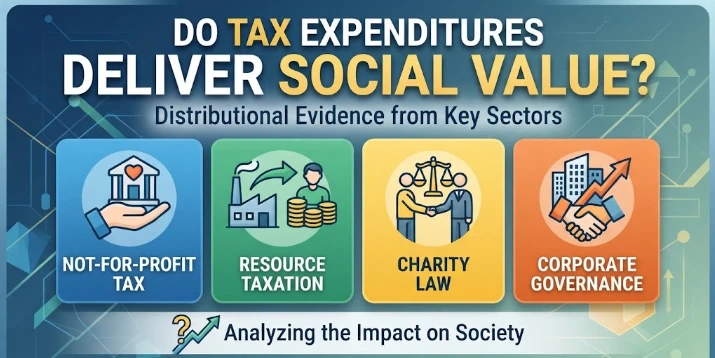
This article evaluates tax expenditures in not-for-profit, charity and resource-tax settings through distribution, governance and public value. Preferential treatment for charities and similar organisations is justified by public or community benefit, so reporting and governance should show whether concessions expand valued services, improve access or instead accumulate as private or organisational advantage. The article warns that annual income alone is an incomplete equity measure because life