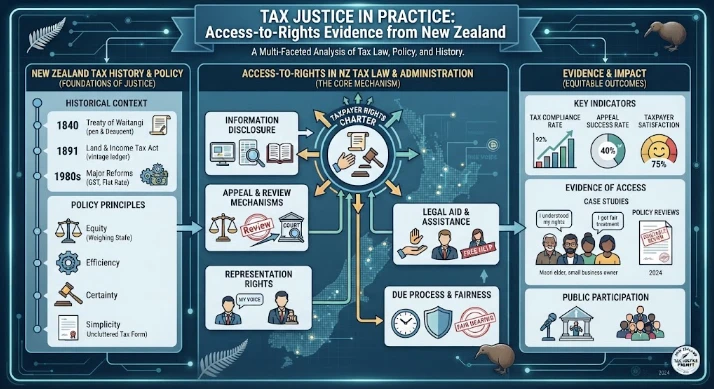
This article reviews New Zealand tax history and policy through the long-standing idea of a broad-base, low-rate system. It traces major reforms from the 1980s, including the introduction of GST, and explains how simplicity, neutrality, efficiency and revenue adequacy have remained important design principles. At the same time, the article shows that those principles are repeatedly tested by debates over capital gains, housing, distribution, Māori interests, digital commerce and international tax coordination. New Zealand’s broad GST base is presented as administratively efficient, while distributional concerns are often addressed through the wider tax-transfer system rather than multiple reduced rates. The article also discusses tax working groups, the absence of a comprehensive capital-gains tax, and the role of Te Tiriti and Māori wellbeing in tax-policy debate. International developments such as BEPS, country-by-country reporting and minimum taxation add further pressure to domestic policy. The overall lesson is institutional: durable tax policy depends on clear principles, transparent consultation, evidence, predictable administration and the capacity to adapt collection mechanisms when economic conditions change.
One of the most succinct descriptions of New Zealand's tax policy is "broad base, low rate. It has influenced great reforms since the 1980s, and continues to play a crucial role in 2026. Broad bases minimize exemptions, preferences, and special regimes, which in turn means that there is a smaller need to tax at very high rates. That's a good way of creating coherence, but history of taxation suggests that simplicity is not a lasting remedy. The model is constantly pushed to the limits of change, politics, distribution, digital trade, housing, and international cooperation.
The current narrative starts with the big economic changes in the 1980s. The previous settings had high marginal income-tax rates and a more limited consumption-tax base, which led to incentives for tax avoidance and complicated tax concessions. Goods and services tax was introduced in 1986.
New Zealand's consumption tax is exceptionally comprehensive by international standards, as it has a broad base and few exemptions. The wide base eliminated classification problems and a single rate made administration easier. The rate gradually increased over time but the principle of the design remained the same.
This model evolved over time with the growth of income taxation. The income tax levy and the company tax are the main revenue contributors, and imputation tax minimises double taxation on income distributed by companies to resident shareholders. New Zealand has also been distinctive from other similar economies in not having a broad-based general capital gains tax. However, specific benefits may be included in the income-tax provisions depending on the asset, use, activity, and specific statutory provisions. This tax has been a source of debate for many years due to the unequal treatment of different types of income, which can impact the fairness, investment decisions, and opportunities for income to be sheltered.
Those tensions have been the subject of numerous tax reviews. The McLeod Review in 2001 looked at the efficiency and fairness of the system and the Victoria University Tax Working Group looked at tax reform following the global financial crisis in 2010. A broad review of the tax policy was conducted by the government appointed Tax Working Group in 2017 and reported in 2019. That group found the system overall was largely successful, but made suggestions in fairness, environmental taxation, integrity, administration and other areas. Most agreed to a more general tax on capital gains and the government rejected that advice.
The capital-gains debate is a recurring battle in New Zealand tax policy. The principle of "equal sacrifice" would also seem to imply that taxes ought to be the same on comparable economic returns, and thus minimize the incentives to manipulate income into one form or another. Political and administrative factors suggest valuation challenges, lock-in issues, compliance costs, transition provisions, and public opposition.
The sensitivity is accentuated with housing, as it is an important component of household assets and political discussion. Instead of creating a permanent settlement, various reforms have changed particular property rules and anti-avoidance variables. History of taxation, therefore, illustrates that a philosophy of a broad base still has to be subject to repeated "boundary decisions.
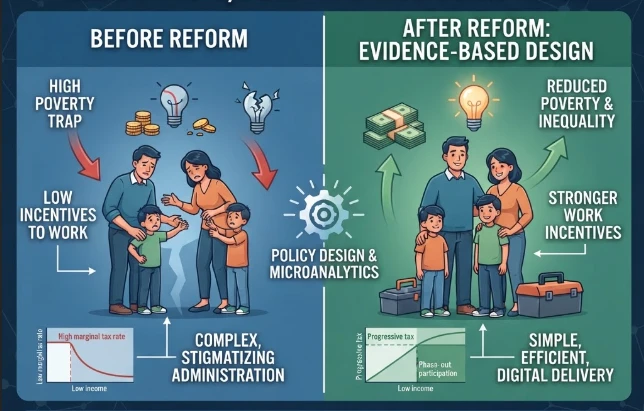
The principle of GST is quite another one. A broad consumption tax is an efficient tax for increasing taxes, but lower income families spend a larger fraction of their current income on consumption. New Zealand has generally avoided large rollouts of reduced rates for essentials, as exemptions can also cause administrative and administrative management challenges, and benefit high spending households too. Distributional issues, on the other hand, are more readily dealt with in the tax-transfer system. That separation of the revenue and the redistribution aspects of the design choice makes it possible to have a broad-based consumption tax, but to provide income support or direct spending to benefit those with the greatest need.
This separation will only function if there are effective transfers. A wide GST may appear regressive if benefit levels, housing costs or income support do not compensate for the regressive impact. The fiscal system as a whole must be considered in assessing the effect of tax analysis, and not each tax instrument individually. Tax decisions are now increasingly seen in the context of broader discussions around wellbeing, fairness, efficiency and intergenerational outcomes through the work of the Treasury relating to the Living Standards Framework, and analysis carried out by Inland Revenue. It is not a matter of whether all taxes are progressive by themselves, but whether the overall tax structure will generate sustainable revenues and provide acceptable distributional outcomes.
There has also been an increasing Māori voice in tax-policy debate. Te Pūwhakauri has undertaken engagement hui with Māori in the 2018 Tax Working Group and there has been an increased focus on Māori wellbeing in public policy analysis as part of broader Treasury work. The impact of these developments is important because seemingly neutral tax rules can have different interactive effects on collective ownership arrangements, limited land, intergenerational stewardship and historic differences in wealth or access to capital. A sound tax system must have principles that allow for these facts without becoming unnecessarily complex. This is in addition to the traditional efficiency analysis, and engagement evidence and distributional evidence are included.
Another area of stress is international taxation. New Zealand's economy is closely tied to cross-border trade and investment, and company taxation needs to be designed to be effective in protecting revenue while being mobile and flexible to meet treaty commitments. There have been external environment changes in the form of the OECD/G20 BEPS project, country-by-country reporting, transfer-pricing rules, and the development of global minimum tax. While domestic tax sovereignty still counts, rules are increasingly part of coordinated frameworks at international level. The real challenge, therefore, is maintaining a stable local community and minimizing the potential for double taxation and for multinational companies to shift profits to other countries.
Breadth is also being put to the test in digital commerce. Consumption is now increasingly happening on offshore platforms and suppliers, which means there is a gap when it comes to traditional collection rules that require physical presence or border processes. Over time New Zealand has responded to this by rolling out a range of measures to increase the scope for collecting GST on imports of services and low-value items.
The above changes illustrate the flexibility of the general rule. The goal was always to have the neutral tax on consumption, but the revenue collection process adjusted with online trade. A fixed tax policy can thus be combined with a large amount of technical reform.
In 1925, Inland Revenue's long-term work was once more looking at the possibilities of a stable tax base to meet the fiscal requirements without sacrificing flexibility of rates. The need for sustainable revenue sources is growing with aging populations, rising health expenditure, infrastructure requirements, climate risks and more. Any of these – increasing rates on existing bases, expanding bases, or shifting tax load from one base to another – come with their own set of trade-offs. Stability has value as investments and decisions by individuals and households are affected by predictability, but too much rigidity can cause the system to become rigid and unresponsive to long-run fiscal change.
Simple is another term that must be carefully interpreted. There can be a relatively small number of big taxes in a tax system with complex rules under them. For international transactions, trusts, employee share schemes, business structures, depreciation, financial arrangements and property provisions, technical detail is required. When economic arrangements are complex, it is legitimate to be complex; each exception sets up more boundaries. Broad-base policy is a discipline to ask if special treatment is required or if the objective could be accomplished through direct spending, and if a concession would provide avoidance opportunities.
Tax history also provides evidence of the significance of institutional process. Consultation, policy development, legislation and post implementation review are traditionally structured under New Zealand's Generic Tax Policy Process. Good process does not eliminate political disagreement, but can help to increase technical quality and uncover unintended consequences before rules are implemented. Institutions are particularly important in cases where tax reform entails compromises that cannot be fleshed out strictly by economic calculations.
The tax system is best viewed as an on-going negotiation of enduring design features and shifting economic contexts by June 2026. The concepts of broad bases, relative neutrality, administrative convenience and revenue sufficiency are still potent, but fairness, how to treat capital income, Māori interests, digital economy, and international tax coordination continue to influence the discussion. History does not suggest an ultimate optimal tax system. Rather, the most important lesson is institutional: stick to clear principles, evaluate reforms using evidence, maintain transparency of concessions, and make changes to collection mechanisms without compromising the simplicity that has long been a strength of the system.
CITE THIS ARTICLE
Sultana, K. R. (2026). Tax Justice in Practice: Access-to-Rights Evidence from New Zealand tax law, tax policy, tax history. https://researchbysultana.com/article/30f17ad9-c466-5e7a-9f02-3cebf7f03551
K. R. Sultana, “Tax Justice in Practice: Access-to-Rights Evidence from New Zealand tax law, tax policy, tax history,” 2026. [Online]. Available: https://researchbysultana.com/article/30f17ad9-c466-5e7a-9f02-3cebf7f03551
Sultana, K. R. (2026) ‘Tax Justice in Practice: Access-to-Rights Evidence from New Zealand tax law, tax policy, tax history’. Available at: https://researchbysultana.com/article/30f17ad9-c466-5e7a-9f02-3cebf7f03551
Sultana, Kazi Rukaiya. “Tax Justice in Practice: Access-to-Rights Evidence from New Zealand tax law, tax policy, tax history.” 2026, https://researchbysultana.com/article/30f17ad9-c466-5e7a-9f02-3cebf7f03551.
Kazi Rukaiya Sultana. “Tax Justice in Practice: Access-to-Rights Evidence from New Zealand tax law, tax policy, tax history.” (2026). https://researchbysultana.com/article/30f17ad9-c466-5e7a-9f02-3cebf7f03551.
Sultana KR. Tax Justice in Practice: Access-to-Rights Evidence from New Zealand tax law, tax policy, tax history. 2026. https://researchbysultana.com/article/30f17ad9-c466-5e7a-9f02-3cebf7f03551
@misc{article_30f17ad9c4665e7a9f023cebf7f03551,
  title = {Tax Justice in Practice: Access-to-Rights Evidence from New Zealand tax law, tax policy, tax history},
  author = {Kazi Rukaiya Sultana},
  year = {2026},
  url = {https://researchbysultana.com/article/30f17ad9-c466-5e7a-9f02-3cebf7f03551},
}
TY  - GEN
AU  - Kazi Rukaiya Sultana
TI  - Tax Justice in Practice: Access-to-Rights Evidence from New Zealand tax law, tax policy, tax history
PY  - 2026-06-14
UR  - https://researchbysultana.com/article/30f17ad9-c466-5e7a-9f02-3cebf7f03551
ER  -
This article uses institutional economics and applied microeconomics to show why tax-transfer reform cannot be evaluated from policy rules alone. Household disposable income reflects earnings, taxes, contributions, benefits, housing support and withdrawal schedules, but the effectiveness of those rules also depends on institutions that administer them. Different data systems, delayed appeals, inconsistent local delivery and administrative capacity can cause a theoretically efficient policy to wo
This article presents tax transparency as a governance and accounting issue rather than a simple disclosure exercise. Boards oversee tax outcomes that are influenced by risk appetite, capital allocation, internal controls, remuneration and significant transactions, while accounting systems provide the common record connecting financial profit, taxable income, deferred tax, cash tax and uncertain positions. IFRS S1 and IFRS S2 are used to show how sustainability-related financial information can
This article evaluates tax expenditures in not-for-profit, charity and resource-tax settings through distribution, governance and public value. Preferential treatment for charities and similar organisations is justified by public or community benefit, so reporting and governance should show whether concessions expand valued services, improve access or instead accumulate as private or organisational advantage. The article warns that annual income alone is an incomplete equity measure because life