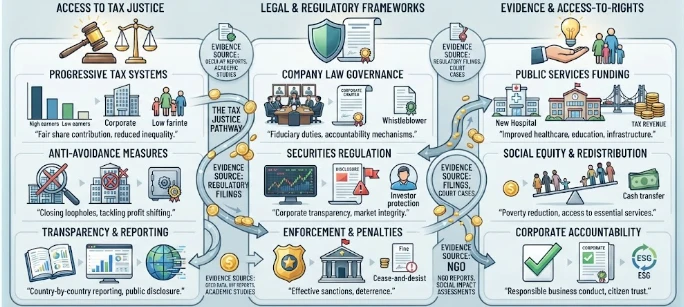
This article extends tax justice beyond rates and redistribution to the practical ability to use legal rights in complex tax systems. Taxpayers need understandable obligations, access to records, communication with authorities, affordable review and predictable procedures. Advanced taxation also intersects with company law and securities regulation because boards, investors, auditors and regulators rely on disclosures concerning tax risk, related-party transactions, deferred tax and uncertain positions. The article argues that legal certainty should not depend entirely on the ability to purchase specialist advice. Public guidance, safe harbours, private rulings and consistent administrative positions can reduce uncertainty while limiting excessive discretion. Enforcement should remain proportionate, distinguishing hardship, error, avoidance and fraud. Tax clinics and tax literacy improve practical access, while small businesses face particular burdens from GST, payroll, record keeping and entity choices. Gender budgeting and fiscal-incidence analysis broaden the fairness assessment by examining household and lifetime effects. Retirement concessions provide another example where access and distribution vary by income and savings capacity. Transparent decisions, effective review and usable rights are presented as core measures of tax-system legitimacy.
The discussion of tax justice is frequently framed as rates and redistribution, but the very first step is access to rights – and this is through procedure. The individual taxpayer must be aware of their duty, obtain their records, communicate with an authority, challenge an assessment, and obtain a review at reasonable expense. When professional advice is required to participate in basic ways, complex law can make it not equal. Access-to-rights analysis thus provides guidance on whether the protections provided by tax law are available to the public and the small business.
Tax justice is not limited to the tax and the individual tax payer; it is also extended by company law and securities regulation. Directors have duties in relation to governance; investors rely on disclosure; and markets evaluate tax risk, among other ways, through financial reporting. Thus, there may be consequences to corporate disclosure even before an assessment is finalized, due to advanced tax arrangements. Legal coordination issues are relevant as tax secrecy, continuous disclosure, tax audit and privilege can all result in information going in opposing directions.
There is also a rule-of-law question as to the certainty of advanced tax issues: certainty should not be available only to those who can afford the services of a specialist interpreter. Private rulings, public guidance, safe harbours and published administrative positions can help to minimize uncertainty, provided these are widely accessible and have consistent reasoning. Risk is created when there is too much discretion, as similar facts may lead to different outcomes. Transparent interpretation can thus be viewed as a justice mechanism, as well as an administrative efficiency tool.
Enforcement should continue to be proportionate. Effective measures against intentional non-compliance safeguard honest taxpayers and the tax base, but measures that are enforced can bring harsh consequences for those who are actually experiencing a hardship or misunderstanding. There is a need to protect, review, and establish clear escalation procedures for debt collection, penalties, garnishment and litigation. The rights-based system treats the root of the problem in a different manner and doesn't reduce the severity of all the problems to a single moral issue.
It is more credible if the access indicators appear next to the revenue indicators. Administrations can monitor complaint results, efforts made to address complaints, complaint processing time, debt stagnation, exclusion from the digital, clinic referral, and common error types. This can help to indicate if there is a friction reduction or a friction re-alignment. The daily functioning of institutions, rather than abstract discussions about statutory rates, is then the basis of tax justice to be measured.
That's where tax clinics come in. The National Tax Clinic program is funded by the Government of Australia to help those who are eligible and small businesses with their tax affairs. Additionally, clinics provide students who are being supervised with learning opportunities and gather evidence of ongoing administrative issues. This comes into play when one-off work comes in, as it can expose systemic issues related to debt, record keeping, registration, family issues, digital access, and/or misreading notices.
Tax Literacy is a second layer of justice. It can save unnecessary debt and penalties to know about filing dates, deductible expenses, business registration, instalment payments and review rights. Literacy is no substitute for simple law; even well-informed taxpayers have difficulty with rules that have numerous definitions and exceptions. Good systems include clear instructions and equitable requirements, and offer easily-available professional or community assistance.
Certainty for business is also provided through a rights-based approach. Anti avoidance rules must be sufficiently far-reaching to cover artificial arrangements, but at the same time companies must have the predictability of standards as regards investment and reporting. The risk of unpredictable enforcement is mitigated by published guidance, review rights and reasoned decision making, and consistent application. Protection of revenue base and protection against arbitrary administration is part of tax justice.
The influence of procedural fairness on voluntary compliance has been extended to include procedural fairness. When there are reasons, evidence is taken into account, there are effective review mechanisms and communication is respectful, there is a greater likelihood that people will accept an adverse outcome. Behavioural tax research has therefore transcended the fear of a tax audit paradigm. Trust cannot substitute for enforcement; however, enforcement that is consistent will make it more legitimate and the less likely outcomes will rely on resources or connections.
Gender budgeting widens the tax-justice lens because rules, that are formally neutral, can have differential impacts on labour-market and household patterns. Incidence can be influenced by variations in paid employment, unpaid care, retirement saving, property ownership and consumption. This is because a budget may be distributionally unequal but fail to include a gender dimension. Gender-sensitive analysis questions who benefits from concessions, who pays consumption taxes, who is eligible for policy credits, and how policy is related to caregiving and lifetime earnings.
The spending part of the fairness equation is added to public finance. Tax justice is not just about who pays as funds are generated for health, education, infrastructure, income support, security, and administration. Fiscal-incidence analysis is used to connect taxes and benefits to get at the overall impact on household resources. This method also avoids the notion of a simple notion of the "fairness" of a single tax without taking into consideration the services and transfers that the system supports.
There are two areas of interaction between company law and securities regulation with tax justice – disclosure and governance. Who is able to see what information with corporate reporting. A number of items, such as related party transactions, incentive provisions, executive provisions, deferred tax, and uncertain tax positions, can be important for risk assessment purposes. Good governance does not deter aggressive tax planning but clear accountability and effective monitoring create difficulties for unearthing tax planning.
Small business has a unique access issue as legal requirements can be similar to those in larger organizations, but lack the expertise in-house. All the enforcement of the GST registration, payroll, deductions, record keeping, and selection of the entity can add up. Clinics and user-friendly advice can prevent minor issues from turning into a debt trap. Simplification is the better long-term answer since the services should not be a permanent cost of unnecessary complexity.
A new aspect of access and distribution is revealed in retirement policy. Tax benefits for superannuation or retirement saving can help to provide support for long term income security, but the fiscal value can be significantly different depending on the amount of contribution, tax rates and account balance. The benefits that are available from deductions that rely on current contributions are limited for lower-income workers. Refundable offsets, contribution caps, preservation rules, age, housing costs and interaction with public pensions are thus taken into account in designing fair pensions.
The practical standard is equal abilities to engage in the tax system. In order for reforms to be implemented that standard demands rules that can be understood, assistance that is affordable, decisions that are transparent, effective review and distributional analysis prior to implementation. Rights have to be valid for collection, as public services rely on it, but the more they are usable, the more legitimate the collection. A tax system is convincing when it is accessible to both income and organisational scrutiny given that it is simple and has enforcement power.
Transparency is thus not seen as a communication activity post-scrutineering, but as a component of the design of the policy architecture. One other benefit of this is hidden trade-offs emerge before thresholds, exemptions or enforcement settings become routine. The underlying message is that the design of a tax should be evaluated by the actual actions rather than by its labels. That is significant because as the legal form and economic incidence change in opposite directions when households or firms respond.
Another protection is to make assumptions explicit so that they are accessible to other analysts to either replicate the central result or question it. The strength of the evidence also is improved when distribution, administration and behaviour are considered together, as opposed to in separate reports. Having agreed upon the assessment criteria ahead of beneficiaries and administrators changing around the standing policy enhances the durability of the policy. What's really tested, though, is the defensibility of a reform once fiscal cost, distribution, complexity, and uncertainty are all on the same page.
Thus, good design considers transparency as an integral component of policy design, and not one that happens after it is created. Yet another benefit of this is that any unwoanted side effects become apparent before that threshold, exemption or enforcement thing becomes a routine practice. The deeper implication is that the design of the fiscal policy should be subjected to behavioural testing rather than being assumed from an institutional description in the legislation.
CITE THIS ARTICLE
Sultana, K. R. (2026). Tax Justice in Practice: Access-to-Rights Evidence from Taxation, advanced taxation issues, company law, securities regulation. https://researchbysultana.com/article/0c2e3d69-ceae-58a0-b3c0-deb583f70fed
K. R. Sultana, “Tax Justice in Practice: Access-to-Rights Evidence from Taxation, advanced taxation issues, company law, securities regulation,” 2026. [Online]. Available: https://researchbysultana.com/article/0c2e3d69-ceae-58a0-b3c0-deb583f70fed
Sultana, K. R. (2026) ‘Tax Justice in Practice: Access-to-Rights Evidence from Taxation, advanced taxation issues, company law, securities regulation’. Available at: https://researchbysultana.com/article/0c2e3d69-ceae-58a0-b3c0-deb583f70fed
Sultana, Kazi Rukaiya. “Tax Justice in Practice: Access-to-Rights Evidence from Taxation, advanced taxation issues, company law, securities regulation.” 2026, https://researchbysultana.com/article/0c2e3d69-ceae-58a0-b3c0-deb583f70fed.
Kazi Rukaiya Sultana. “Tax Justice in Practice: Access-to-Rights Evidence from Taxation, advanced taxation issues, company law, securities regulation.” (2026). https://researchbysultana.com/article/0c2e3d69-ceae-58a0-b3c0-deb583f70fed.
Sultana KR. Tax Justice in Practice: Access-to-Rights Evidence from Taxation, advanced taxation issues, company law, securities regulation. 2026. https://researchbysultana.com/article/0c2e3d69-ceae-58a0-b3c0-deb583f70fed
@misc{article_0c2e3d69ceae58a0b3c0deb583f70fed,
  title = {Tax Justice in Practice: Access-to-Rights Evidence from Taxation, advanced taxation issues, company law, securities regulation},
  author = {Kazi Rukaiya Sultana},
  year = {2026},
  url = {https://researchbysultana.com/article/0c2e3d69-ceae-58a0-b3c0-deb583f70fed},
}
TY  - GEN
AU  - Kazi Rukaiya Sultana
TI  - Tax Justice in Practice: Access-to-Rights Evidence from Taxation, advanced taxation issues, company law, securities regulation
PY  - 2026-01-28
UR  - https://researchbysultana.com/article/0c2e3d69-ceae-58a0-b3c0-deb583f70fed
ER  -
This article uses institutional economics and applied microeconomics to show why tax-transfer reform cannot be evaluated from policy rules alone. Household disposable income reflects earnings, taxes, contributions, benefits, housing support and withdrawal schedules, but the effectiveness of those rules also depends on institutions that administer them. Different data systems, delayed appeals, inconsistent local delivery and administrative capacity can cause a theoretically efficient policy to wo
This article presents tax transparency as a governance and accounting issue rather than a simple disclosure exercise. Boards oversee tax outcomes that are influenced by risk appetite, capital allocation, internal controls, remuneration and significant transactions, while accounting systems provide the common record connecting financial profit, taxable income, deferred tax, cash tax and uncertain positions. IFRS S1 and IFRS S2 are used to show how sustainability-related financial information can
This article evaluates tax expenditures in not-for-profit, charity and resource-tax settings through distribution, governance and public value. Preferential treatment for charities and similar organisations is justified by public or community benefit, so reporting and governance should show whether concessions expand valued services, improve access or instead accumulate as private or organisational advantage. The article warns that annual income alone is an incomplete equity measure because life