The evidence on Tax-Transfer Reform, Poverty Reduction, and Work Incentives in Public finance, taxation, public expenditure, public debt, social welfare, and fiscal policy.
Kazi Rukaiya Sultana (Master of Public Policy & Master of Social Welfare and Research)
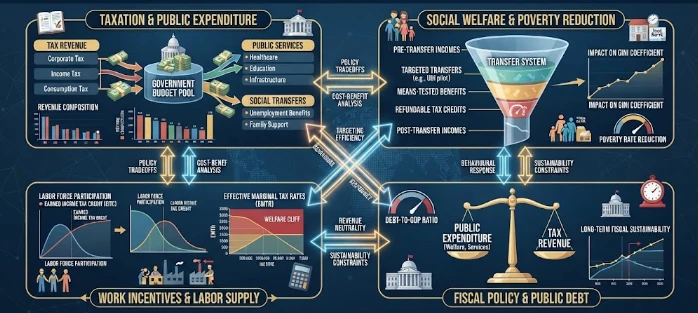
This article presents tax-transfer reform as an integrated public-finance problem involving taxation, public expenditure, social welfare and public debt. Governments need revenue for health, education, infrastructure, pensions and debt service while households need protection from poverty and a predictable financial return from work. The article argues that tax policy should therefore be assessed together with spending and transfer policy rather than as separate systems. Work incentives depend on the interaction of income tax, social contributions and benefit withdrawal, and can be weakened when several forms of support decline at the same earnings level. In-work benefits, childcare, transport and public services all affect whether employment improves household welfare. Fiscal sustainability remains important because ageing, interest costs and long-term spending pressures shape the space available for reform. The article discusses tax expenditures, expenditure reviews, automatic stabilisers and compliance as potential areas for improving fiscal capacity without indiscriminate cuts. Poverty is also treated as broader than income alone, including housing and material hardship. Successful reform combines distributional analysis, sustainable financing, accessible services and credible tax administration.
The most difficult part of tax-transfer reform is when all the fiscal goals are pressing simultaneously. Governments require income to fund health, education, infrastructure, pensions, social protection, and debt service, and households want to be protected from poverty and have benefits for their efforts. Increasing taxes can increase the capacity of the fiscal system but have some costs in terms of less incentives or less disposable income. Reducing expenditure may help balance the budget, but reduce services and transfers that lead to employment and social stability. The central public-finance problem that has to be addressed by the beginning of April 2026 is integration: the assessment of tax, expenditure, welfare and debt policies should be made within one fiscal system.
First, there is a constraint in public finance. In the future, government spending will have to be paid for through taxes and other revenue, borrowing, or changes in the public balance sheet. While debt may be useful for financing investment that will yield productive returns, it can also increase interest payments in the future and can also make it harder to implement policies when an unexpected recession occurs. Social programmes and capital investment face high interest costs. Fiscal sustainability does not mean that debt should be removed, it means that revenue and expenditure, growth and financing can be sustainable in the medium and long-term.
Tax policy has a broader than revenue goal. Tax structure can influence the distribution of income, investment, labour supply, consumption, savings and compliance. Vertical equity can be provided by progressive personal taxes, and revenue can be raised with fewer distortions on broad bases.
Consumption taxes can generate revenue in a more stable fashion, but may be detrimental to low-income consumers without the offset of transfers or other adjustments. Corporate taxes shield a portion of the capital-income base but take place in a world of international mobility of profit and investment. A well balanced system is required not relying entirely on a single instrument.
Distributional role of public expenditure is also significant. OECD research on budgeting and inequality has highlighted that spending can help to decrease inequality through cash transfers and public services. Household welfare is influenced by the provision of education, health, child care, housing assistance, transport and by active labour market programmes, without any money being deposited into a bank account. A tax cut can boost disposable income as soon as it is received, a public service can lower expenses or enhance future earning potential. In order to compare fiscal policy, it is necessary to focus on both cash income and in-kind benefits.
Social welfare falls smack dab in the middle. Those not equally covered by the private market take risks like unemployment, low incomes, disability, housing costs, and old age, which are mitigated by unemployment benefits, minimum income support, family payments, housing assistance, disability support, and pensions. Adequacy, because if benefits fall short of the basic standards of living, then those who receive them may become poor.
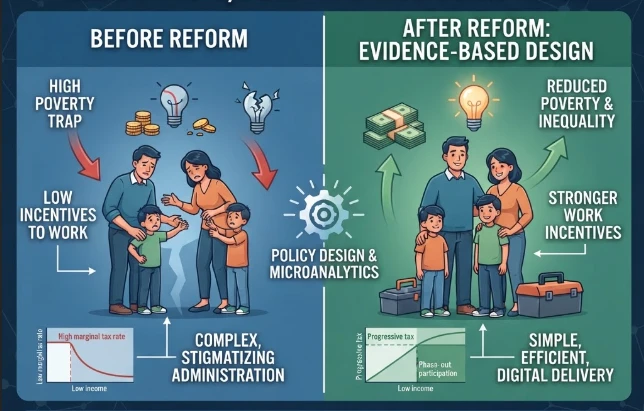
The importance of work incentives stems from the fact that support can decline with increasing earnings. The right design issue is not about being either generous or gainful. It is developing a path that leads to a predictable increase in net household resources as a result of taking work and working more.
Effective marginal tax rates shed light on where that route can go wrong. If a worker's salary increases, he/she may be subject to a higher income tax rate and social contributions, and facing the simultaneous withdrawal of several benefits. With a low statutory tax rate, the additional pay can be offset by the losses of both parties. The interaction may be particularly expensive when housing and childcare support is also required. The job of reform, therefore, is to chart the entire tax-benefit schedule and to eliminate any unwanted cliffs, not to modify one scheme without taking into account the other.
In-work benefits can provide assistance. A refundable credit or earnings supplement will increase the return on low-paid labor and help to maintain household income. It is important to design the phase-out rate carefully, as a steep gradient can establish a ‘low wage trap' higher in the earnings ladder.
Cost of childcare is also an issue, as a small increase in an employee's pay may be lost if costs of childcare increase. There are therefore fiscal, as well as service, work incentives. The availability of transport, child care, training and health care can make it either possible or impossible to have a job.
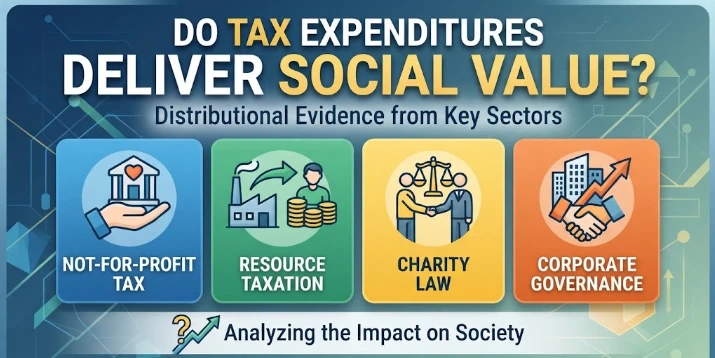
Targeted reforms are still expensive, and that can make these decisions difficult in the light of the debt pressure. Better fiscal space should be achieved through progress on three broad fronts: cutting poorly targeted tax expenditures, enhancing compliance, and improving spending efficiency, as well as increasing tax bases. These measures may be less harmful than a general decrease in benefits or a sudden tax hike. Tax expenditures are worthy of special mention because the grants can be more akin to spending, and they are not as heavily reviewed on an annual basis. A periodic review will be able to flag provisions that provide low social or economic value.
Similarly, expenditure reviews can fulfil this function on the expenditure side. The goal should aim for re-allocation to programmes that have better outcomes instead of a simple reduction. The social programme could be redesigned with a reduced administrative cost and higher uptake, and the preventive health programme or childcare programme could generate benefits that would only manifest over time. Evaluation requires outcome measures, distributional analysis and realistic counterfactuals. Consolidation that does not take account of programme quality can lead to lower expenditure in the short run and higher social costs in the long run.
Economic cycles matter. In a downturn, when tax revenues decline, so do the various expenditures related to unemployment, and such expenditures automatically boost household income and demand. Automatic stabilisers are a virtue of tax-transfer systems because they increase automatically, without the need for new legislation for each shock. But if governments are under pressure to cut in response to an economic downturn, overly strict fiscal rules will have a negative effect on that function. Temporary deficits in the short run can be accommodated in a credible medium-term framework that provides a longer-term debt path.
Structural challenge with population ageing. Pensions and health costs can increase over many years and not in short bursts. This pressure necessitates gradual reform that can impose significant losses on specific cohorts if implemented at once. These can involve contribution changes, eligibility changes, tax reform, service efficiency – or policies which increase labour force participation and productivity. Distribution is important as people have different life expectancy, levels of health, wealth, caring responsibilities and ability to work for longer periods.
The benefits themselves are not the ultimate measure of poverty. Housing, debt, service use, energy, transport, and taxes and transfers impact a household's disposable income. While relative poverty measures are appropriate for comparison, there are aspects of hardship that can be captured by material deprivation and housing stress that are missed by income measures. The fiscal policy should thus be evaluated on the basis of various types of households and areas. The immediate distributional impacts can be estimated by microsimulation and the administrative and survey data can show actual impacts following the reform.
Tax compliance is also important for fiscal credibility. A tax gap that is high relative to the statutory rate could harm both revenue and public trust in a tax system that tolerates a high tax gap. The base can be safeguarded by robust third-party reporting, digital administration, risk-based audit, international cooperation and easy taxpayer services.
Compliance policy should continue to be proportional. There must be a way to correct the record for those who are truly having administrative problems but are not looking to evade, and there must be something that can be done credibly to enforce the record if they are doing it on purpose. Fairness (or fairness perception) encourages voluntary compliance by making rules appear more convincing to taxpayers that they ought to comply with them.
The whole structure is connected by transparency. It should be clear from the budgets how the spending is directly allocated, how the spending is offset by tax expenditures, how the spending is financed by debt, what fiscal risks are associated with the spending, and how the spending affects distribution in a manner that can be compared. Structural pressures can be detected in long-term projections in advance of crisis-driven decisions.
Public explanation is also important if there are visible losers to the reform. There is a risk of a policy package being economically sound but politically fragile if the compensation, the timing and the rationale are unclear. Legitimacy, in addition to arithmetic, is needed for durable fiscal reform.
Tax-transfer reform by 05-04-2026 will likely be best conceived as a series of related decisions. In order to reduce poverty, there is a need for adequate support and accessible services, for work incentives, the tax-benefit schedule needs to be taken into account, for public debt, it is necessary to have long-term equilibrium between revenue and expenditure, and for fiscal sustainability, it is necessary to have both economic growth and restraint. The most effective reform programme includes protection of economical and redistributive spending, audit of ineffective tax incentives, expansion of effective tax bases, tax smoothing, toughening tax enforcement and tax benefit distribution review prior to implementation. Fiscal responsibility and social welfare are not mutually exclusive objectives if the policy is directed at the quality, timing and distribution of both taxes and benefits.
CITE THIS ARTICLE
Sultana, K. R. (2026). The evidence on Tax-Transfer Reform, Poverty Reduction, and Work Incentives in Public finance, taxation, public expenditure, public debt, social welfare, and fiscal policy.. https://researchbysultana.com/article/0bce64ef-604f-53d1-bdf8-916940ff7723
K. R. Sultana, “The evidence on Tax-Transfer Reform, Poverty Reduction, and Work Incentives in Public finance, taxation, public expenditure, public debt, social welfare, and fiscal policy.,” 2026. [Online]. Available: https://researchbysultana.com/article/0bce64ef-604f-53d1-bdf8-916940ff7723
Sultana, K. R. (2026) ‘The evidence on Tax-Transfer Reform, Poverty Reduction, and Work Incentives in Public finance, taxation, public expenditure, public debt, social welfare, and fiscal policy.’. Available at: https://researchbysultana.com/article/0bce64ef-604f-53d1-bdf8-916940ff7723
Sultana, Kazi Rukaiya. “The evidence on Tax-Transfer Reform, Poverty Reduction, and Work Incentives in Public finance, taxation, public expenditure, public debt, social welfare, and fiscal policy..” 2026, https://researchbysultana.com/article/0bce64ef-604f-53d1-bdf8-916940ff7723.
Kazi Rukaiya Sultana. “The evidence on Tax-Transfer Reform, Poverty Reduction, and Work Incentives in Public finance, taxation, public expenditure, public debt, social welfare, and fiscal policy..” (2026). https://researchbysultana.com/article/0bce64ef-604f-53d1-bdf8-916940ff7723.
Sultana KR. The evidence on Tax-Transfer Reform, Poverty Reduction, and Work Incentives in Public finance, taxation, public expenditure, public debt, social welfare, and fiscal policy.. 2026. https://researchbysultana.com/article/0bce64ef-604f-53d1-bdf8-916940ff7723
@misc{article_0bce64ef604f53d1bdf8916940ff7723,
  title = {The evidence on Tax-Transfer Reform, Poverty Reduction, and Work Incentives in Public finance, taxation, public expenditure, public debt, social welfare, and fiscal policy.},
  author = {Kazi Rukaiya Sultana},
  year = {2026},
  url = {https://researchbysultana.com/article/0bce64ef-604f-53d1-bdf8-916940ff7723},
}
TY  - GEN
AU  - Kazi Rukaiya Sultana
TI  - The evidence on Tax-Transfer Reform, Poverty Reduction, and Work Incentives in Public finance, taxation, public expenditure, public debt, social welfare, and fiscal policy.
PY  - 2026-04-05
UR  - https://researchbysultana.com/article/0bce64ef-604f-53d1-bdf8-916940ff7723
ER  -
This article uses institutional economics and applied microeconomics to show why tax-transfer reform cannot be evaluated from policy rules alone. Household disposable income reflects earnings, taxes, contributions, benefits, housing support and withdrawal schedules, but the effectiveness of those rules also depends on institutions that administer them. Different data systems, delayed appeals, inconsistent local delivery and administrative capacity can cause a theoretically efficient policy to wo
This article presents tax transparency as a governance and accounting issue rather than a simple disclosure exercise. Boards oversee tax outcomes that are influenced by risk appetite, capital allocation, internal controls, remuneration and significant transactions, while accounting systems provide the common record connecting financial profit, taxable income, deferred tax, cash tax and uncertain positions. IFRS S1 and IFRS S2 are used to show how sustainability-related financial information can
This article evaluates tax expenditures in not-for-profit, charity and resource-tax settings through distribution, governance and public value. Preferential treatment for charities and similar organisations is justified by public or community benefit, so reporting and governance should show whether concessions expand valued services, improve access or instead accumulate as private or organisational advantage. The article warns that annual income alone is an incomplete equity measure because life