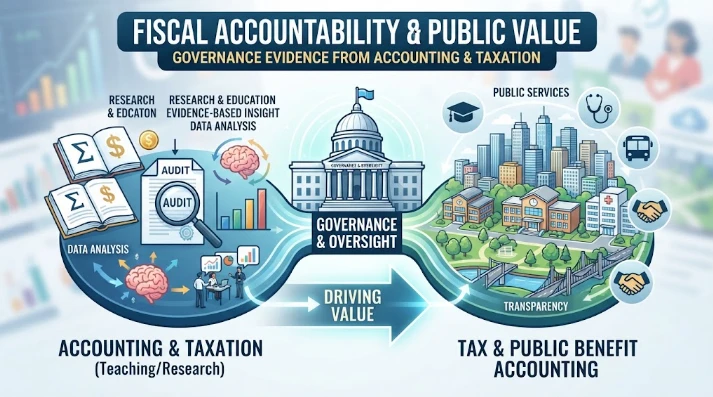
The article connects fiscal accountability with accounting, taxation teaching, research and public-benefit reporting. It begins from the idea that every tax collected, concession granted or public resource used should be linked to an identifiable public purpose and assessed against outcomes. Fiscal transparency requires more than budget totals because forecasts can differ from actual collections as economic growth, prices, behaviour, litigation and policy take-up change. Tax-gap analysis and microsimulation provide complementary evidence about under-collection and distribution, helping policymakers avoid focusing on revenue alone. Institutional design is important because tax policy and administration involve ministries, revenue bodies, legislatures, auditors, courts and professional communities. Accounting supplies a language for tax revenue, receivables, provisions, transfers and public assets, while tax-expenditure statements expose support delivered through the tax code. GST and VAT demonstrate the need to balance efficient collection, timely refunds and targeted verification. The article also argues that tax education and research should integrate ethics, governance, economics and administration. Broader scorecards and feedback from practice can support simplification, accountability and durable public trust.
The first public value question is fiscal, namely: what is the outcome of every unit of money raised or saved? Collective priorities are financed by taxes, exemptions and concessions allocate resources through the tax code. There are many systems that have broad based revenue from GST and VAT but the design of these systems impacts distribution, compliance burden and political legitimacy. Governance is thus linked to revenue performance and transparency, equity, service quality and the credibility of the institutions involved in the collection and spending of revenues.
Public-benefit accounting is a useful link between technical accounting and fiscal legitimacy. Reporting should be carried out for organisations receiving concessions or public funds which demonstrates how they use their resources to achieve their social objectives. Such cases can be used in tax education to link up laws with governance, ethics and public finance. Then, research can be used to determine whether the reporting leads to improvements in behaviour or whether it is merely an increase in paperwork without greater accountability.
There's also consistency between budget promises and subsequent results in fiscal transparency. Forecasts may vary from collections due to changes in economic growth, prices, tax-payer behaviour, litigation and policy uptake. Failure is not a given when there is variance. Increased accountability when authorities provide reasons for large differences, revise their assumptions and maintain time series for external review.
More research on tax gaps and tax distribution can further elaborate that explanation. Gap estimates pinpoint places in which the legal responsibilities for collecting taxes are not being met, and microsimulation demonstrates the impact of taxes and transfers on households in the income spectrum. When these views are melded together, they avoid the self-reduction focus on revenue. A policy may be efficient in its collection, but ineffective in its distribution, or it may be effective in its distribution on paper but ineffective in practice because of poor compliance, which undermines the policy's legitimacy.
The importance of institutional design is because the tax policy and tax administration are a cross-cutting issue that is spread across ministries, revenue officers, legislatures, auditors, courts, and professional communities. Responsibilities are made clear to minimize duplication and easier to identify failures. Independent review and external audit can be performed to determine the credibility of internal assurance. Legal protections and purpose restrictions still need to be in place to support cross-agency data sharing and enhance analysis.
Good governance also recognises uncertainty. The estimates of tax expenditure, behavioural effects and compliance gaps are based on imperfect data and models. In publishing methodology and uncertainty ranges informed disagreement is possible, without triggering a credibility crisis. Transparency regarding constraints can contribute to building trust, as stakeholders are able to differentiate between what is true and what is assumed.
Accountability manifests itself in many ways and is expressed in language by accounting. Financial statements include tax revenue, tax receivables, provisions, transfers and public assets, and budget documents provide explanations for policy decisions and predictions. Tax-expenditure statements fill in the picture by revealing revenue losses due to special tax provisions. This can make it that a government can increase its fiscal support by way of the tax system, and this would not be reflected in the conventional figures of expenditures.
The future capacity of revenue agencies, firms, advisers, courts, and policy units are also impacted by taxation teaching. Good programmes are a mix of doctrine and empirical research, accounting, economics, and administration. Supervision for research can enhance that balance by fostering inquiries into distribution, compliance, and institutional performance. The value of fiscal accountability is enhanced when professional knowledge not only extends to the technical aspect of the job, but also to considerations of broader public consequences.
GST and VAT also provide a good example of the role that administrative performance plays. Efficient collection can be facilitated by broad bases and invoice trails, however exemptions, thresholds, refunds and sector rules cause pressure points. It can have a negative effect on business cash flow if it takes too long to get back to them and on revenue if it is not properly verified. Public value is a balance of having a service that is fast for acceptable companies and effective controls to address claims from high-risk companies.
A new theme that has emerged in the OECD Tax Administration series is the quest to eliminate non-compliance and the burden of routine tasks through digitalisation. When systems are reliable, pre-filled data, online accounts, standardised reporting and analytics can minimise the friction. There is still a need for governance relating to privacy, cybersecurity, access, procurement, and algorithmic decisions in the context of digital transformation. Efficiency gains are not public good if they are achieved in a process that is hidden from public view or excludes taxpayers who cannot access digital channels.
Cost-of-collection ratios should, therefore, be replaced by measures of performance. Low administrative costs can be an indicator of efficiency but can also coexist with unmet needs, substandard service and/or inadequate investment in more complex cases. Revenue assurance, voluntary compliance, processing time, dispute resolution, taxpayer burden, staff capability and trust are all considered to be strong scorecards. There is no single indicator that will reflect the quality of a tax administration.
Education and research gives them a better ability to make good professional judgments and thus increases accountability. Complex taxation is not just a matter of law and economics and accounting and data and ethics – it is also a design of institutions, and the narrow technical training stuff can miss important consequences. Doctoral supervision and research groups provide the research environment for testing assumptions, providing policy evaluation and for identifying ways to address tax gap issues, distributional incidence and compliance behaviour. It's when that research is in practice, through transparent evidence and not confined within the boundaries of academic publication that public value grows.
Professional norms are also influenced by teaching. For students who are only taught about tax in terms of minimising the amount of tax, the best way to achieve success is to defend the least amount of tax. Ethics and administrative justice, public finance, governance and the economic rationale for taxation rules can be incorporated into a wider curriculum. It is not a substitute for sound legal analysis, but rather it builds on technical competence and deepens its understanding.
For charities, social enterprises and those awarded tax concessions, public-benefit accounting entails similar issues. The preferential treatment tends to be a policy decision that a qualifying activity generates social value. Accountability means that evidence must be provided that benefits must be derived and not be used for private gain. Reporting rules, governance standards, related-party controls and eligibility definitions safeguard revenues and public confidence.
Feedback is the key to fiscal accountability. Administrative, judicial, clinical, business, research and community evidence can show where policies impose unintended costs. Evaluation should result in simplification, re-designed thresholds, improved guidance or tightened controls when evidence indicates a need for change. Public value does not mean collecting as much as possible, whatever it takes, but maintaining a fair, understandable and effective revenue system to fund proper public uses.
The underlying message is that the design of fiscal measures should be subject to empirical scrutiny, not taken for granted from their statutory description. That is important because the legal form and the economic incidence go in opposite directions after adjustment by households or firms. Another protection is to state the assumptions in a manner that allows other researchers to replicate or contest the main finding. Increase the strength of the evidence when distribution, administration and behaviour are reported together.
The durability of the policy is enhanced if those who benefit from the policy and those responsible for administering it agree on prior to them adapting around a permanent policy. The real test is whether the reform is defensible once the fiscal cost, the distribution of it, how complicated it is, and the uncertainty surrounding it are all displayed on the same page. Good design, then, sees transparency as a component of policy design and not as a communication task once the policy has been put in place. The other benefit of this is that you can see the hidden trade-offs before they become routine practice in terms of thresholds or exemptions or enforcement settings.
The underlying message is that fiscal design should be evaluated based on its actual effects rather than on the labels under which it is placed in the statute books. But that's important because when households and firms respond, legal form and economic incidence will go in opposite ways. Another piece of protection is to make explicit the assumptions that allow one to come to the central result so that someone else can reconstruct or question the result. Distribution, administration and behaviour are also considered together with the evidence that leads to stronger evidence.
Criteria for evaluating the effectiveness of the policy are more likely to be accepted if they are agreed to in advance of beneficiaries and administrators adapting to an enduring policy. What's really good for the budget, who gets the benefit and who doesn't, how complex is it, and how uncertain are the outcomes: these are the practical questions that remain to be answered. Good design, thus, must not be about making something transparent as a communication task after it is designed, but part of its architecture.
CITE THIS ARTICLE
Sultana, K. R. (2025). Fiscal Accountability and Public Value: Governance Evidence from Accounting, taxation teaching/research; tax, public benefit accounting context. https://researchbysultana.com/article/1ed518f6-d45e-5b36-94a9-83daf90eaa6e
K. R. Sultana, “Fiscal Accountability and Public Value: Governance Evidence from Accounting, taxation teaching/research; tax, public benefit accounting context,” 2025. [Online]. Available: https://researchbysultana.com/article/1ed518f6-d45e-5b36-94a9-83daf90eaa6e
Sultana, K. R. (2025) ‘Fiscal Accountability and Public Value: Governance Evidence from Accounting, taxation teaching/research; tax, public benefit accounting context’. Available at: https://researchbysultana.com/article/1ed518f6-d45e-5b36-94a9-83daf90eaa6e
Sultana, Kazi Rukaiya. “Fiscal Accountability and Public Value: Governance Evidence from Accounting, taxation teaching/research; tax, public benefit accounting context.” 2025, https://researchbysultana.com/article/1ed518f6-d45e-5b36-94a9-83daf90eaa6e.
Kazi Rukaiya Sultana. “Fiscal Accountability and Public Value: Governance Evidence from Accounting, taxation teaching/research; tax, public benefit accounting context.” (2025). https://researchbysultana.com/article/1ed518f6-d45e-5b36-94a9-83daf90eaa6e.
Sultana KR. Fiscal Accountability and Public Value: Governance Evidence from Accounting, taxation teaching/research; tax, public benefit accounting context. 2025. https://researchbysultana.com/article/1ed518f6-d45e-5b36-94a9-83daf90eaa6e
@misc{article_1ed518f6d45e5b3694a983daf90eaa6e,
  title = {Fiscal Accountability and Public Value: Governance Evidence from Accounting, taxation teaching/research; tax, public benefit accounting context},
  author = {Kazi Rukaiya Sultana},
  year = {2025},
  url = {https://researchbysultana.com/article/1ed518f6-d45e-5b36-94a9-83daf90eaa6e},
}
TY  - GEN
AU  - Kazi Rukaiya Sultana
TI  - Fiscal Accountability and Public Value: Governance Evidence from Accounting, taxation teaching/research; tax, public benefit accounting context
PY  - 2025-11-19
UR  - https://researchbysultana.com/article/1ed518f6-d45e-5b36-94a9-83daf90eaa6e
ER  -
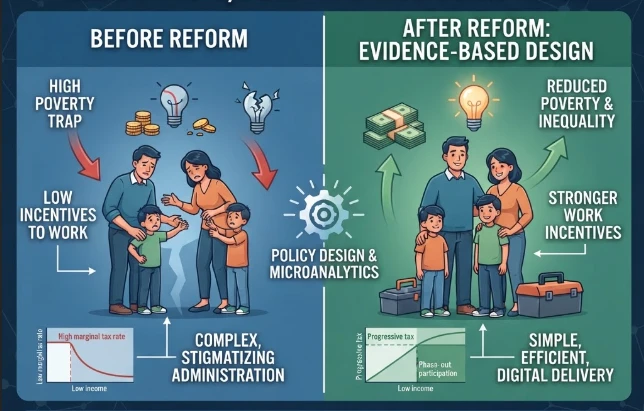
This article uses institutional economics and applied microeconomics to show why tax-transfer reform cannot be evaluated from policy rules alone. Household disposable income reflects earnings, taxes, contributions, benefits, housing support and withdrawal schedules, but the effectiveness of those rules also depends on institutions that administer them. Different data systems, delayed appeals, inconsistent local delivery and administrative capacity can cause a theoretically efficient policy to wo
This article presents tax transparency as a governance and accounting issue rather than a simple disclosure exercise. Boards oversee tax outcomes that are influenced by risk appetite, capital allocation, internal controls, remuneration and significant transactions, while accounting systems provide the common record connecting financial profit, taxable income, deferred tax, cash tax and uncertain positions. IFRS S1 and IFRS S2 are used to show how sustainability-related financial information can
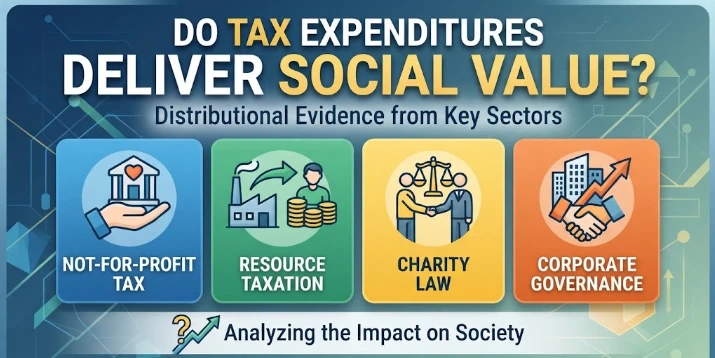
This article evaluates tax expenditures in not-for-profit, charity and resource-tax settings through distribution, governance and public value. Preferential treatment for charities and similar organisations is justified by public or community benefit, so reporting and governance should show whether concessions expand valued services, improve access or instead accumulate as private or organisational advantage. The article warns that annual income alone is an incomplete equity measure because life