Do Tax Expenditures Deliver Social Value? Distributional Evidence from Housing Tax Concessions, Wealth Inequality, Intergenerational Equity, and Fiscal Incidence
Kazi Rukaiya Sultana (Master of Public Policy & Master of Social Welfare and Research)
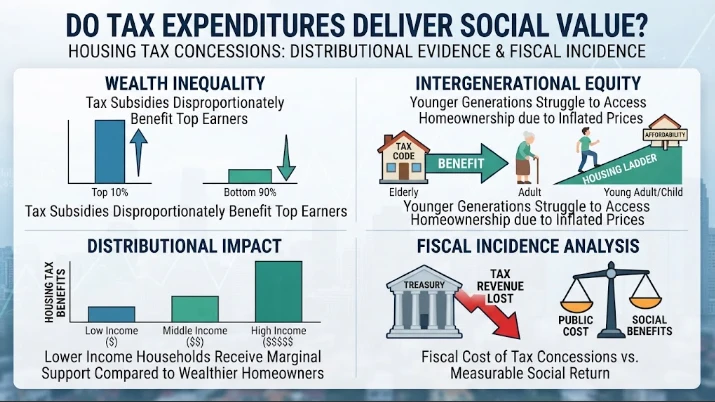
This article assesses the social value of housing tax concessions through wealth inequality, intergenerational equity and fiscal incidence. It argues that household welfare is shaped by the full tax-transfer system, but housing concessions require a wealth lens because benefits depend on asset ownership, leverage, taxable income, capital gains treatment and the tax status of owner-occupied or investment property. Renters and households without assets may benefit less directly, while tax preferences can also influence prices and rents. Fiscal-incidence analysis should therefore identify who receives the concession, who bears the revenue cost and how behavioural responses affect the housing market. The article connects housing with human capital, noting that stable housing and related transfers can support education, childcare and future earnings. Consumption taxes and other fiscal instruments must also be assessed within the overall distributional system. Australia’s tax-expenditure reporting is discussed as a way to make housing-related revenue forgone more visible, while acknowledging that repeal would change behaviour, asset prices and timing. A credible social-value assessment needs lifetime and intergenerational analysis, not only annual income comparisons.
Tax-transfer policy does not operate directly on the tax rate, but on disposable income. The income, earnings, cash benefits, family payments, withdrawal rules and housing support are put together in a single household budget. A tax rate reduction which yields a modest increase may still result in a modest gain after the second payment is taken. The appropriate thing to focus on in terms of poverty and work incentives is thus the household's overall budget constraint at various income levels.
The example of housing tax concessions helps to illustrate the need for using a wealth lens, in addition to an income lens, for tax-expenditure analysis. After-tax returns for households and property types can be different after adjusting for investment expenses, concessional taxation of capital gains, owner-occupied housing treatment and targeted credits. Ownership, taxable income, leveraging, and realized gains are important factors that influence benefits, with individuals who do not own assets or are renting homes benefiting less directly. The fiscal incidence must therefore pinpoint who can be considered the concession taker, who the revenue cost taker, and what is the reaction of prices/rents.
The design of welfare programs forms another connection between welfare and long run productivity through human capital. Transfers designed to benefit nutrition, housing stability, child care access and/or education participation can benefit future earnings, even if fiscal accounts appear to be a cost in the short run. On the other hand, negative training benefits that discourage training income or uncertainty in studying may discourage skill investment. A responsible work incentive system, however, takes a long-term perspective on labour supply, as well as on how the rules affect the capacity to earn in the future.
Public economics also cautions against taking all behavioural reactions as being of social benefit. Any increase in the supply of formal labour which raises the supply of labour to the market can alter the extent of unpaid care provided in a household, alter the demand for care, or have an impact on the market power. Two-sided markets are more complicated because a tax levy on a platform or provider could have impact on both sides of the market. It is not just a matter of the name of the legal taxpayer as mandated by legislation, but also elasticities and market structure.
This distributional conflict is particularly evident in consumption taxes. Broad consumption taxes can be an efficient way to raise revenue, but for lower-income groups, taxes will result in a higher proportion of current income being spent. Lower rates for necessities could help to alleviate that burden but could also mean significant absolute savings for high-income households. Regrepression may be addressed more directly through targeted transfers when administrative systems have a consistent and reliable identification of eligible households and payment rules are easy to understand.
Progressivity should be measured throughout the overall fiscal system. The final pattern can be modified by the introduction of progressive personal income tax, consumption taxes, payroll contribution, housing subsidy and benefit withdrawal. The benefits of following the fiscal incidence, as evidenced in new New Zealand fiscal incidence work, is that taxes and benefits can be followed through household income, and not judged on their own merits. A similar analysis shows that the seemingly progressive reform may actually have no impact on the level of inequality across the life cycles, across the year, or both.
Australia's tax-expenditure reporting has always been able to identify housing-related concessions, but to do so in the context of a statement of revenue forgone. This is not necessarily equal to the cash available upon immediate repeal as there would be changes in behaviour, asset prices, timing and transitional rules under reform. Regardless of this, publication clarifies scale and distribution. A concession can help attract investments or savings as well as boost the relative gain for the current owners, particularly if there is scarce supply of housing which constrains the rate of change in quantity supply.
As well as the generosity that is prescribed by law, administrative design also has an impact on outcomes. Delays in the process, complex forms, debt recovery and potentially complex reconciliation may lead to reduced take-up or hardship. Automatic data matching and pre-filled data can facilitate access, but digital technologies require ways to meet the needs of those with language, disability, connectivity, or record-keeping challenges. Welfare gains from a reform do not materialise if the households who are eligible for it are not easily accessible to or not comprehensible by the reform.
Sustainability of the fiscal balance is kept in the calculation of equity. Persistent deficits can result in transfers to future generations, and badly targeted tax cuts can lead to a decline in tax revenues to finance high-value services. Sustainable reform not only establishes a stable financial foundation, but also provides clarity on distributional decisions. That way, poverty reduction, incentives and funding for public services can be measured as related goals, instead of as competing catchcry slogans.
Averages mask people impacted by interacting rules and thus microsimulation has been the focal point of that analysis. The New Zealand Treasury model called TAWA (Tax and Welfare) has been used for distributional, fiscal-incidence and effective marginal-rate analysis and is applied to representative microdata. OECD inequality budgeting also provides an overview of the general adoption of tax-and-spending microsimulation in advanced administrations. These tools help to put the issues of reform in the debates more tangible terms by depicting outcomes by income deciles, family types and labour-market status.
There are competing forces at play in policy when support is narrowly targeted, both towards poverty reduction and towards work incentives. A generous benefit is a shelter for low incomes, but can be tight at the top if benefits are quickly phased out as income grows. This is the percentage of each additional unit of income that is subject to an increase in taxes and a decrease in transfer payments. High rates are not necessarily indicative of low employment levels, but they reveal where higher levels of work generate a surprisingly small increase in the amount of people's income left to spend.
The issue becomes more complicated due to intergenerational equity. Older or established households may have larger housing wealth, while younger households may have to make a large investment to enter the housing market, make a deposit, pay rent, and have unknown tax situations in the future. An abrupt change in asset values by reform could result in transition losses, and an indefinite preservation could result in the status quo. A defensible approach is the one that considers fiscal incidence, housing-supply policy, renter outcomes, a distribution of wealth, and a gradual transition and not each concession individually by looking at annual revenue forgone.
Generosity is not a design determinant; a withdrawal's quality is determined by its shape. Gradual tapers can help ease the transition to work, abrupt thresholds can help create cliffs and impact hours, timing or formal reporting. Incentive effects of individual taxation may be greater than those of family based taxation in some situations while the need of the household may be more specifically addressed by family based transfers. There are thus trade-offs between equity, fiscal cost, targeting, and administrative feasibility in the design of a policy.
Economic welfare is a more comprehensive measure than employment. In addition to increasing output and incomes, extra work can also reduce the welfare of the household by reducing the time available to commute, care for children, and maintain their health, among other factors. In a short-term perspective of employment, this appears to be a successful reform as it raises the supply of labour; in a longer term perspective of income security, this may be a less successful reform as it adversely affects a vulnerable group. Strong evaluation follows the employment, hours, available income, depth of poverty and fiscal costs together.
Mobility is important because households experience income mobility over time. Temporary low income can result from studying, caring for others, being out of work, or from business fluctuations and/or early work years, and persistent low income represents a different policy challenge. The single-year modelling of tax transfers can detect incidence in one year but not in all. Longitudinal evidence can help to tell whether support contributes to the stabilisation of temporary shocks, decreases the incidence of persistent poverty, or alters opportunities for upward mobility.
The best packages for reform incorporate modelling as a decision-making tool rather than mere window-dressing following policy decisions. Distributional tables, effective-marginal-rate profiles, behavioural sensitivity tests and fiscal scenarios can be developed prior to legislation. This allows thresholds to be based on the results, taper rates, refundable credits and transition rules to be designed. Political decisions cannot be replaced by evidence, but by highlighting hidden trade-offs, evidence can limit the likelihood of a headline creating a complicated household reality.
For long-term reform, this means that institutional change is needed to adjust thresholds, procedures, and reporting requirements based on evidence. A durable system is one that is both accessible and has a clear procedure and accountability, while protecting revenue. These are then kept within one analytical frame through a sound evaluation. It's when the rule generates quantifiable public benefit – when the costs to the public (fiscal, implementing, unintended) are subtracted from the benefit it offers.
CITE THIS ARTICLE
Sultana, K. R. (2025). Do Tax Expenditures Deliver Social Value? Distributional Evidence from Housing Tax Concessions, Wealth Inequality, Intergenerational Equity, and Fiscal Incidence. https://researchbysultana.com/article/063eefbe-2285-594f-92b4-7aa2de7bbfc9
K. R. Sultana, “Do Tax Expenditures Deliver Social Value? Distributional Evidence from Housing Tax Concessions, Wealth Inequality, Intergenerational Equity, and Fiscal Incidence,” 2025. [Online]. Available: https://researchbysultana.com/article/063eefbe-2285-594f-92b4-7aa2de7bbfc9
Sultana, K. R. (2025) ‘Do Tax Expenditures Deliver Social Value? Distributional Evidence from Housing Tax Concessions, Wealth Inequality, Intergenerational Equity, and Fiscal Incidence’. Available at: https://researchbysultana.com/article/063eefbe-2285-594f-92b4-7aa2de7bbfc9
Sultana, Kazi Rukaiya. “Do Tax Expenditures Deliver Social Value? Distributional Evidence from Housing Tax Concessions, Wealth Inequality, Intergenerational Equity, and Fiscal Incidence.” 2025, https://researchbysultana.com/article/063eefbe-2285-594f-92b4-7aa2de7bbfc9.
Kazi Rukaiya Sultana. “Do Tax Expenditures Deliver Social Value? Distributional Evidence from Housing Tax Concessions, Wealth Inequality, Intergenerational Equity, and Fiscal Incidence.” (2025). https://researchbysultana.com/article/063eefbe-2285-594f-92b4-7aa2de7bbfc9.
Sultana KR. Do Tax Expenditures Deliver Social Value? Distributional Evidence from Housing Tax Concessions, Wealth Inequality, Intergenerational Equity, and Fiscal Incidence. 2025. https://researchbysultana.com/article/063eefbe-2285-594f-92b4-7aa2de7bbfc9
@misc{article_063eefbe2285594f92b47aa2de7bbfc9,
  title = {Do Tax Expenditures Deliver Social Value? Distributional Evidence from Housing Tax Concessions, Wealth Inequality, Intergenerational Equity, and Fiscal Incidence},
  author = {Kazi Rukaiya Sultana},
  year = {2025},
  url = {https://researchbysultana.com/article/063eefbe-2285-594f-92b4-7aa2de7bbfc9},
}
TY  - GEN
AU  - Kazi Rukaiya Sultana
TI  - Do Tax Expenditures Deliver Social Value? Distributional Evidence from Housing Tax Concessions, Wealth Inequality, Intergenerational Equity, and Fiscal Incidence
PY  - 2025-02-23
UR  - https://researchbysultana.com/article/063eefbe-2285-594f-92b4-7aa2de7bbfc9
ER  -
This article uses institutional economics and applied microeconomics to show why tax-transfer reform cannot be evaluated from policy rules alone. Household disposable income reflects earnings, taxes, contributions, benefits, housing support and withdrawal schedules, but the effectiveness of those rules also depends on institutions that administer them. Different data systems, delayed appeals, inconsistent local delivery and administrative capacity can cause a theoretically efficient policy to wo
This article presents tax transparency as a governance and accounting issue rather than a simple disclosure exercise. Boards oversee tax outcomes that are influenced by risk appetite, capital allocation, internal controls, remuneration and significant transactions, while accounting systems provide the common record connecting financial profit, taxable income, deferred tax, cash tax and uncertain positions. IFRS S1 and IFRS S2 are used to show how sustainability-related financial information can
This article evaluates tax expenditures in not-for-profit, charity and resource-tax settings through distribution, governance and public value. Preferential treatment for charities and similar organisations is justified by public or community benefit, so reporting and governance should show whether concessions expand valued services, improve access or instead accumulate as private or organisational advantage. The article warns that annual income alone is an incomplete equity measure because life